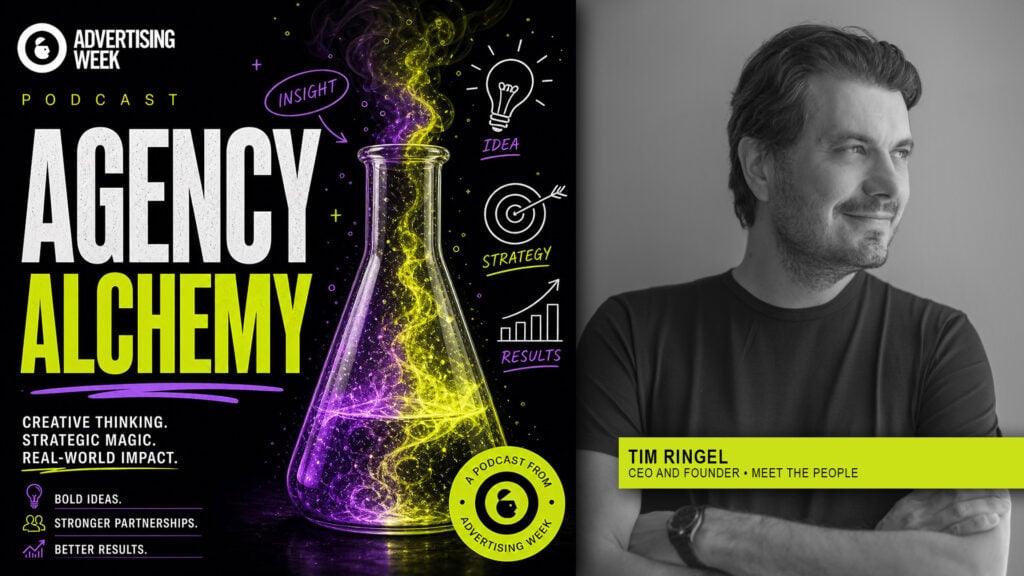
What does it take to build an 850-person agency group without recreating the bureaucracy of a traditional holding company? And as AI transforms the economics of advertising, should agencies be focused on cutting costs or creating more value?
In this episode of Agency Alchemy, Tim Ringel, Founder and Global CEO of Meet the People, joins us to discuss his journey from launching an agency with two people in a German basement to leading a network of ten specialized agencies across North America.
Tim explains why he believes the traditional holding company model often works against clients’ interests, how Meet the People combines creative, media, commerce, and technology without sacrificing specialist expertise, and why mid-market brands represent a significant opportunity for a new generation of agency groups.
The conversation also explores AI’s impact on agency business models, the shift from hourly billing to deliverable-based pricing, and why AI-driven efficiency should be reinvested in growth rather than used simply to reduce headcount. Tim also shares candid lessons about navigating crises, earning long-term client trust, and building leadership teams around transparency, complementary strengths, and shared incentives.
It’s a conversation about entrepreneurship, adaptability, and what the next generation of successful agencies will need to get right.
Five Key Takeaways
1. Agency silos are an organizational problem, not a client requirement.
Ringel argues that traditional holding companies have often allowed internal P&Ls, departmental incentives, and organizational politics to interfere with delivering integrated solutions. Meet the People was built to overcome those barriers by bringing specialist agencies together around client business objectives rather than individual disciplines or budgets.
2. The mid-market is a major opportunity for integrated agency groups.
Large holding companies can be too expensive or complex for mid-sized advertisers, while independent specialists often lack the resources to deliver comprehensive solutions. Ringel sees an opportunity for agency groups that combine specialized capabilities with direct access to senior leadership and the flexibility to challenge client briefs.
3. AI efficiency should fund differentiation, not just cost reductions.
Rather than treating AI primarily as an opportunity to eliminate jobs, Ringel believes agencies should reinvest productivity gains into better services, stronger capabilities, and greater client impact. His preferred measure of success is how much additional value and revenue employees can generate with AI as an amplifier.
4. Creative agencies need to rethink how they charge for their work.
As AI reduces the time and resources needed to produce creative assets, traditional time-and-materials pricing is becoming increasingly difficult to defend. Ringel explains how Meet the People has shifted more than 95% of its creative business toward deliverable-based models that reward outcomes and milestones rather than hours worked.
5. Trust, transparency, and aligned incentives remain the foundations of great leadership.
Drawing on nearly three decades of agency leadership, including navigating the pandemic, Ringel emphasizes the importance of authentic communication, building teams with complementary strengths, and empowering people to make decisions. He argues that lasting client relationships and successful agency cultures depend on human connection, particularly when technology makes transactional services easier to replace.
Listen & Subscribe