




Healthcare marketing has never had a shortage of information. The challenge is getting people to stop, pay attention, understand it, and remember it. That’s especially difficult when the subject matter is complex, highly regulated, and often being presented to healthcare professionals who are already overwhelmed with information. Experiential marketing offers healthcare brands something increasingly difficult to create through another screen: the chance to make complicated science tangible, invite people into the story, and create the kind of human connection that can build trust.
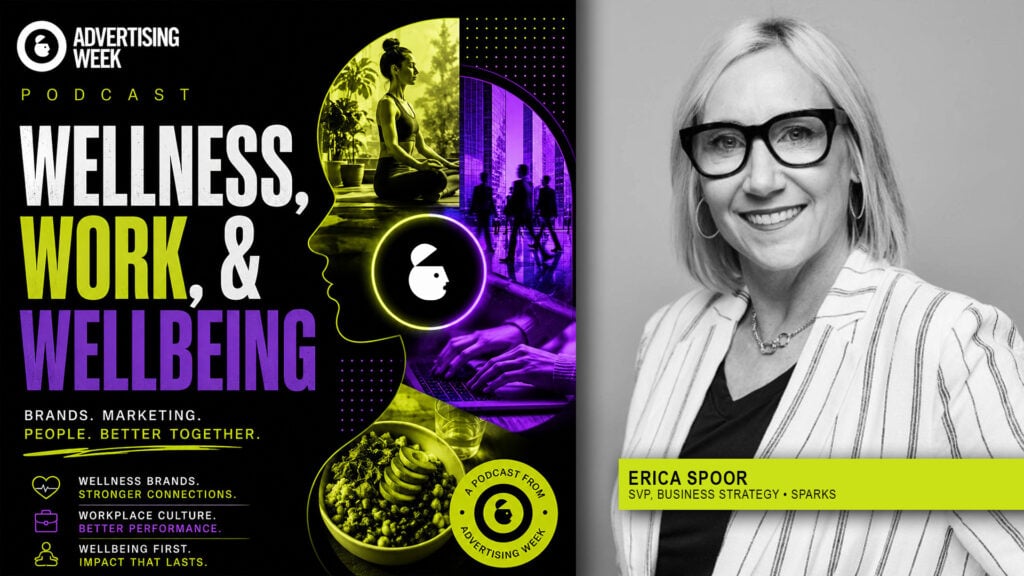
In this episode of Wellness, Work & Wellbeing, we are joined by Erica Spoor, SVP Business Growth & Strategy at Sparks, to talk about how healthcare brands can use experiential marketing to turn complex science into something people can actually understand and engage with. We discuss why in-person experiences are becoming more valuable in an increasingly digital healthcare world, how brands can simplify without sacrificing the science, and why the best experiences don’t end when the event does.
Five Key Takeaways
1. Complex science needs a simple way in.
Healthcare brands have a lot to communicate, and much of it can’t simply be left out. But that doesn’t mean every piece of information needs to hit the audience at once. Erica points to an experience built around the eight-minute dosing time of a COPD drug, using a clock as the central idea throughout the space. The science was still there for healthcare providers who wanted to go deeper, but the experience gave them one memorable idea to start with.
2. In-person experiences can build something digital healthcare struggles with: Trust.
Healthcare is becoming increasingly digital, from telehealth to direct-to-consumer access to prescription medications. At the same time, both patients and providers are dealing with more information, more marketing, and more reasons to question what they see online. Erica sees live experiences as an opportunity for healthcare brands to create real conversations, give people access to knowledgeable experts, and let them experience products, devices, and information firsthand.
3. If people can get it online, don’t make that the centerpiece of an in-person experience.
A room full of screens isn’t necessarily an experience. Erica says Sparks is increasingly designing healthcare environments around conversation, hands-on learning, and the ability for attendees to move through information at their own pace. For GoodRx, that meant creating an open environment with places for providers to sit down and have conversations rather than surrounding them with monitors. For Alcon, it meant putting technology directly into people’s hands so they could see how it worked.
4. The experience shouldn’t begin and end at the event.
Experiential marketing works harder when it connects to everything happening before and after the event. Erica describes thinking about programs across the entire journey: what brings someone into the experience, what happens while they’re there, and how the ideas, content and conversations continue afterward. In healthcare, those extensions can reach all the way into the doctor’s office or pharmacy, turning a single activation into part of a much larger brand experience.
5. Healthcare brands may need to take more creative risks.
Scientific accuracy and regulatory requirements aren’t reasons for healthcare marketing to be forgettable. Erica believes some of the brands getting the most from experiential are the ones willing to move beyond the expected exhibit and find physical, memorable ways to tell the story. That could mean an eight-minute clock, a walk-through model of a blood vessel, or even starting a conversation over a cup of coffee. The detailed science remains available, but the experience starts with curiosity, patient outcomes, and the human side of healthcare.
Listen & Subscribe