





Every Brand Has a Social Contract; It’s Time to Articulate Yours

What if you could understand how your brand shows up across every space – from your content, to the comment section, to the subreddit? This article introduces the Social Contracts – Fandom, Conversation and Moment – the three archetypes that make a brand’s relationship with its audience visible, and actionable. It is the third in a five-part series exploring the findings of the Brand Currency Index™ – a proprietary study by Social Element measuring the value of brands on social media.
Most brands have a positioning. Some even have a useful one.
The stronger versions are built from proper customer understanding, reflecting what the brand can credibly offer, what makes it meaningfully different from competitors and what customers actually care about. Done well, they define the place the brand needs to occupy in the customer’s mind.
Positioning only matters if it shapes behaviour. Specifically, the behaviour of a brand out in the real world, beyond the PowerPoint deck: fragmented channels, overlapping communities, changing expectations, cultural moments, customer conversations, complaints, jokes, recommendations, rituals and all the messy interactions through which people make sense of the world they live in.
That is where many brands start to drift, and even if they do know what they want to mean, that doesn’t mean they know what they should do. They may have a positioning, but find themselves lacking in either how it should shape execution or the structures that make execution possible.
Often “more” is the answer: More posts. More formats. More moments. More attempts to be relevant. More effort spent interrupting the interactions people are already having. Communication that happens not for the intended audience, but for the internal stakeholders. Doing “stuff” becomes a substitute for choiceful decision-making.
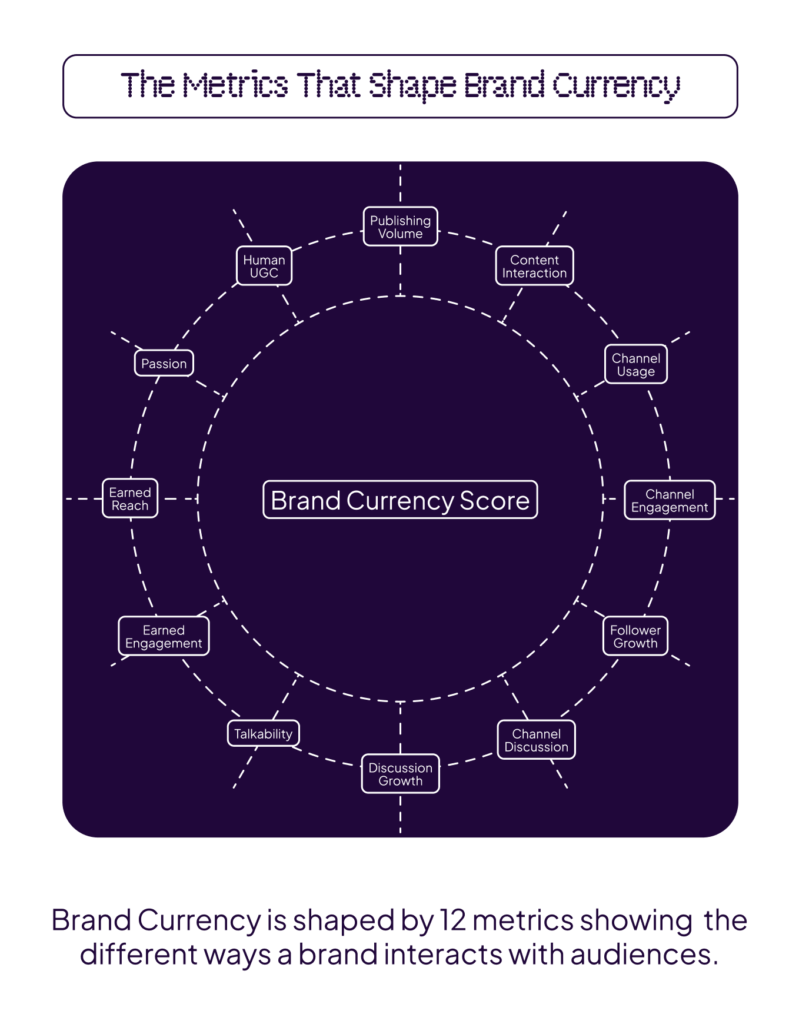
Brand Currency helps change that by providing a clearer view of how a brand already exists in and around communities. It shows where the brand has strength, where it has permission, where it is being shared, where it is being ignored and where it is mistaking presence for participation.
From there, marketers can articulate something more useful than another content plan; they can articulate the brand’s social contract.
A social contract is the lens that shapes execution. It defines how a brand should behave in the communities that matter so that its activity may reinforce the position it needs to hold in customers’ minds.
Without a social contract, brands default to posting.
Social activity has become ever easier to produce, but very hard to make mean anything at all. Data from Social Element’s Brand Currency Index of nearly 500 brands shows there were over 470.7K social media posts in 2025 – a 10% increase from 2024. Yet, the average engagement per post for these brands fell by 11% year-over-year. The pressure to keep doing is constant, but a brand can be extremely active without building much value.
It can post every day and still add nothing to the community. It can jump on every trend and still feel out of place. It can speak in the language of the platform and still say nothing that reinforces the brand.
This happens when execution is shaped by the demands of the channel rather than the dynamics of the community.
People are not waiting for most brands to join their conversations. They are busy with their friends, interests, complaints, fandoms, routines, jokes, worries and plans. They are talking about what matters to them, not what matters to the content calendar.
If a brand enters those spaces without understanding the terms of participation, it becomes noise, which people have become very good at filtering out.
Brand Currency Index™ 2026
The social contract forces a different set of questions: What kind of interaction is already happening here? What does this category normally “allow” brands to do? What does the community reward? What does it reject? What role does the brand currently hold and what role does it need to build? What would be useful, credible or welcome? What would feel cringe?
These are execution questions, but they need to connect what the brand means (positioning) with how the brand should behave (execution).
Positioning still starts in the customer’s mind.
This point matters because the social contract can’t become another way for brands to indulge themselves; to invent a personality and throw it at the internet; to behave like an entertainer if the category requires expertise, care or reassurance. To chase the community for community’s sake.
A good social contract has to serve the brand’s positioning. If the brand needs to be understood as reliable, execution has to reinforce reliability. If it needs to be seen as inventive, execution has to demonstrate invention. If it needs to be trusted, execution has to behave with care. If it needs to be part of a fandom, execution has to give people material to belong with, more than just “messages” to receive.
The point is to make the brand’s desired position more visible, credible and repeatable through the interactions people actually experience.
This is where many brand models are exposed. They can sound compelling in theory, but become vague when it comes to actually making anything happen out in the real world.
In a less fragmented world, brands could get away with that. Fewer channels, fewer contexts and more concentrated attention made weak implications easier to hide. Today, vague, over-engineered positioning leaks everywhere. It shows up as inconsistent tone, disconnected content, opportunistic partnerships, reactive posting and activity that makes sense in a calendar but not in the customer’s life.
(And that’s only the “P” of promotion, let alone things like Price, Product or Place)
The social contract defines the terms of participation.
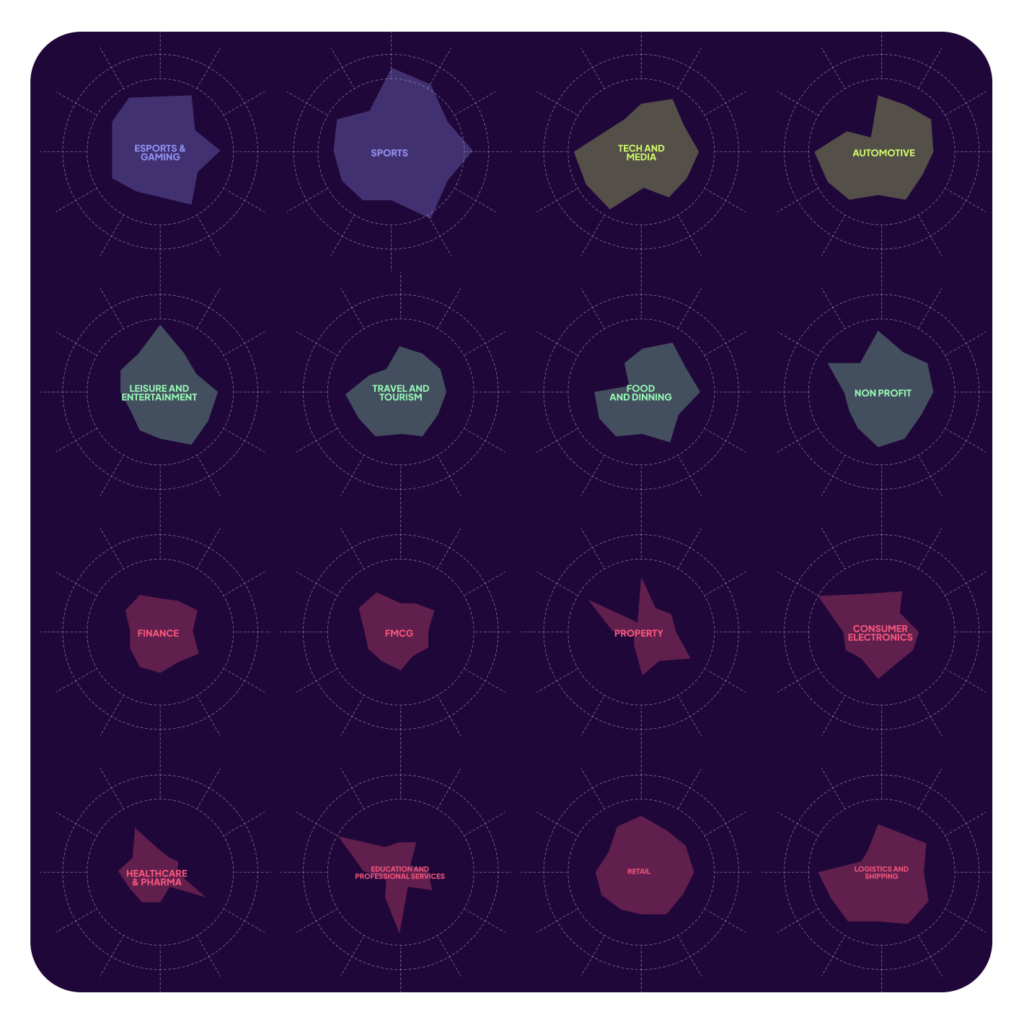
Every category has interaction dynamics.
Sports brands operate in worlds of loyalty, rivalry, ritual and identity. Gaming brands often live through creation, mastery, participation and shared worlds. Travel and leisure brands trade in anticipation, experience, proof and memory. Food brands can move through appetite, routine, value, humour or occasion. Finance and healthcare work with trust, clarity, usefulness, reassurance, and responsiveness.
Brand Currency Index™ 2026
These dynamics are not fixed rules, but they are real. Like all category dynamics, they shape what people will accept from a brand, what they will carry forward and what they will ignore.
A social contract makes those dynamics explicit, setting out the terms on which the brand participates. Not in a bureaucratic way, and not as another brand book nobody uses.
What position are we trying to reinforce? Which communities matter to that position? What do those communities already value? What role do we have today? Where do we have permission to stretch? What behaviours would strengthen our currency? What behaviours would damage it? How do we show up in a way that feels distinctive to us, rather than borrowed from the platform?
Brand Currency makes that contract evidence-based.
The value of Brand Currency is that it stops this being guesswork.
It shows how the brand is currently experienced across Owned, Community and Earned signals. It shows whether the brand is building through its own presence, through its interactions with the audience or through the extent to which that audience is interacting with others, and using the brand as part of those interactions.
The shape shows how currency is being formed.
A brand may be strong in earned attention but weak in community depth. It may publish constantly but generate little movement. It may have a large audience that does not participate. It may be highly talked about but not warmly felt. It may sit close to the category average, doing enough to be present but not enough to be distinctive.
Those patterns are useful because they point to execution choices.
If the brand needs to build trust, the contract may need to prioritise responsiveness, clarity and usefulness. If it needs to build identity, it may need to give people more ways to claim, display or participate. If it needs to build salience, it may need to create moments people can gather around. If it needs to move out of functional invisibility, it may need to find the part of the category where people already have something to say.
This is how Brand Currency helps turn understanding into action. It helps clarify a category’s default behaviour, the communities’ interaction patterns and the brand’s current permission.
From there, it is possible to make deliberate choices. To fit the contract where credibility matters, to stretch it where the brand has permission or to reshape it where it’s role needs changing.
The strongest brands make deliberate choices.
The examples in Social Element’s Brand Currency are powerful because they are not all doing the same thing.
Lego behaves like a fandom brand by giving people ways to build, collect, belong and create. Aldi turns value into conversation, making supermarket behaviour feel public, playful and culturally useful. Ralph Lauren attaches itself to moments its audience already treats as meaningful. Formula 1 made a technical sport easier to enter, follow and belong to. Royal Caribbean turned the ship itself into a product experience people want to film, share and retell as their own story.

Brand Currency Index™ 2026
The lesson is not that every brand should copy them. The lesson is that each has found a way to make execution reinforce a positioning people can understand.
They are not just producing content. They are behaving in line with a contract.
That is what makes the idea useful for marketers. It moves the conversation away from whether a brand is “good at social” and towards whether the brand is behaving in ways that build the position it needs to hold.
For some brands, that will mean being more responsive. For others, more entertaining. For others, more useful, more expert, more participatory, more selective, more consistent or more willing to stay quiet when there is no credible role to play.
It takes us beyond “constant participation” and towards participation that strengthens a brand’s positioning.
Articulate the contract before briefing the work.
Before briefing another campaign, creator partnership, content calendar or channel plan, marketers need to be able to articulate the social contract that sits behind it.
Where does the business need to go? What position does the brand need to hold in customers’ minds? Which communities matter to that ambition? What are the interaction dynamics of those communities? What role does the brand currently earn? What kind of behaviour would reinforce the desired position? What should the brand stop doing because it creates activity without movement?
These questions help creative teams understand the job beyond “make something engaging” and help social teams avoid the pressure to post for the sake of posting. They help strategists connect the brand model to the reality of customer interaction. They help measurement teams judge whether activity is building the right kind of currency.
Every brand already has a social contract. It exists in the expectations people have of the category, the role they currently give the brand, the interactions they allow and the behaviours they reward or reject.
The danger is leaving that contract unmanaged or unfulfilled.
Without clarity, the gap is filled with noise. Brands chasing attention, mimicking competitors, following platform habits and mistaking activity for progress.
When it is articulated, execution has a clearer job. It can adapt to the dynamics of the community without losing the brand identity. It can participate with permission. It can reinforce the position the brand needs to hold, one interaction at a time.
That is what marketers should do once they understand their Brand Currency.
Use it to see the contract. Then use the contract to shape the work.
You May Also Like

Design Is Britain’s Unsung Hero. It’s Time We Said So.
The UK design economy is worth £136.7bn and growing almost twice as fast as the wider economy. So why are we still so bad at recognising its value?

Count Me In – The Case for Total TV
We know that television still fills the room. Ask almost any advertiser and they will tell you the audience is larger than ever, gathered around bigger, brighter TVs.

Research Designed for the Decisions Advertisers Make
Advertisers have more choices than ever when deciding where to invest their media budgets.