





Fame Is Not the Same as Currency

Have you ever wondered how your brand stacks up against others on social – not just your competitors, but other industries? This article explores what the Brand Currency Index rankings reveal – and why the most famous brands are not always the most valuable. From Ryanair at #23 to Google at #130, the data separates fame from genuine community value. It is the second in a five-part series exploring the findings of the Brand Currency Index™ – a proprietary study by Social Element measuring the value of brands on social media.
There will be brands in the Brand Currency Index that make marketers pause. Some will be higher than expected (e.l.f #20 punching way above its weight in beauty). Some will be lower (Google #130). Some of the most famous names in the world may not sit where their awareness, revenue, media spend or cultural history suggests they should.
That reaction is useful, because a ranking should provoke questions. Why is that brand higher (Ryanair #23 higher than premium and/or legacy carriers)? Why is that brand missing[1] [2] ? Why does a company everyone knows (a global, legacy brand like Coca Cola #108, McDonald’s #98) seem to matter less than a brand with a smaller footprint (Peacock #9, Aerie #48)?
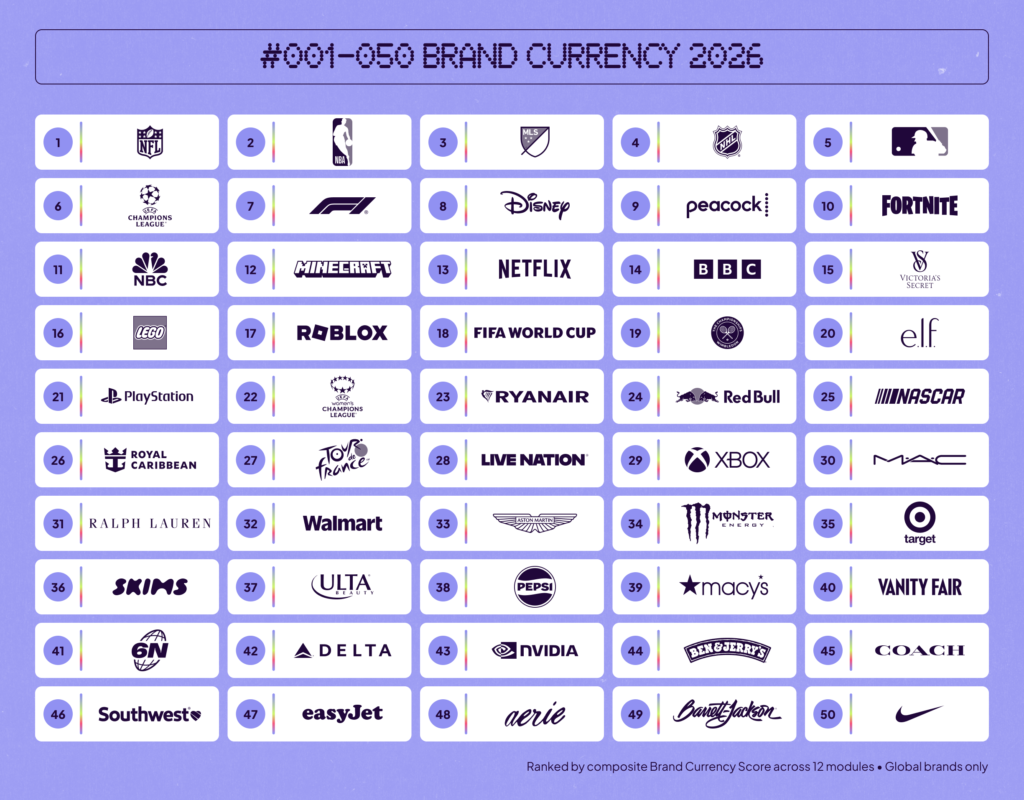
Brand Currency Index™ 2026
Those questions are the point. The Brand Currency Index is not a list of the biggest brands. It is not a fame league. It is not a measure of who spends most, posts most, shouts loudest or occupies the most shelf space in the public mind.
It measures something more nuanced; how much currency does a brand carry inside the communities where a brand’s audiences interact?
That distinction matters because fame and currency are easily confused.
They overlap. They feed each other. They can make each other stronger. But they are not the same thing.
A brand is famous because people know it, while it has currency when people do something with it.
They can use it to start a conversation, prove they were part of something, recommend something useful, express a view, share a joke or take a side.
Fame gets a brand recognised. Currency gets a brand carried.
Big brands can still be weakly carried
Marketers have good reasons to care about scale.
Big brands (like Ford, DHL or Colgate) are visible. They are bought. They are recognised. They have distribution, history, media investment and presence. Those things matter. No serious marketer should pretend otherwise.
But scale is not evidence of social value.
A brand can be enormous and still have a limited role in the interactions between people. It can be familiar without being talked about. It can sit in the background of life, useful and profitable, while rarely moving through the communities that shape meaning, influence and memory.
That does not make them weak businesses. It means their community value may be weaker than their fame suggests.
This is an uncomfortable distinction because it separates being known from being used socially. Many brands have spent years building awareness and availability, then assumed that the job of modern media is to distribute more messages more efficiently.
That is still part of the job. Visibility matters. Distinctiveness matters. Reach matters.
But visibility alone does not tell us whether a brand has any movement inside the systems where people exchange meaning. A brand may be seen by millions and still leave very little behind.
Brand Currency asks a different question. It looks at whether the brand earns movement inside communities.
What flows? What travels? What gets exchanged? What do people repeat, share, respond to, argue with, build on or take into their own lives?
Those questions change how we read brand strength. They explain why some famous brands may underperform. They also explain why some brands with smaller overall awareness can punch much harder than expected.
Presence is different to relevance
One of the oldest habits in marketing is to treat the world as a map of spaces where messages can be placed. Where can we advertise? Where can we reach people? Where can we get attention? Where can we show up?
Those are still useful questions. But they are not enough.
Communities are active systems of interaction. People are already talking, sharing, mocking, recommending, ignoring, copying, judging and signalling. They already have language, rituals, references, expectations and boundaries.
A brand can enter those spaces with money. It cannot buy its way into mattering there.
This is where many famous brands struggle. They assume presence will become relevance. They appear in the feed, in the partnership, in the sponsorship in the moment, in the content calendar. They are technically there. But being there is not the same as having a role.
The strongest brands understand this. They do more than show up Lego (#16) provides a shared language for creative imagination. Red Bull (#24) provides a spectacle for people to gather around. They know what they are there to do.
Sometimes that role is to entertain. Sometimes it is to inform. Sometimes it is to help. Sometimes it is to provide status (Ralph Lauren #31), access, proof, identity ( NFL #1, NBA #2, Minecraft #12, and Fortnite #10), reassurance, spectacle ( Formula 1 #7) escape (Royal Caribbean #26) or a shared reference point (Disney #8). Sometimes it is simply to be ready when people need a response.
The role depends on the brand, the category and the community.
This matters because the social world is unforgiving to brands that mistake access for permission. People may tolerate a brand’s presence. That does not mean they have any reason to carry it forward.
Plenty of brands are present in people’s lives. Far fewer are useful inside the interactions people actually care about.
That is the gap Brand Currency exposes.
A bank may be essential, but that does not automatically make it socially valuable. A healthcare brand may be trusted, but that does not mean people want to include it in their everyday conversations. A logistics company may be part of millions of transactions, but that does not mean it becomes part of culture.
The brand may be needed, while not actually having momentum.
The brands at the top give people something to use
Look at the brands and categories that perform strongly. Sports. Gaming. Streaming. Travel. Entertainment. Food. Leisure. Experience-led brands. Brands that create moments. Brands that give people something to gather around, argue about, belong to or remember.
These categories sit close to the behaviours communities are built from. Sides to take. Worlds to enter, build or master. Stories to talk about. Proof I was “there.” These brands create material for interaction.
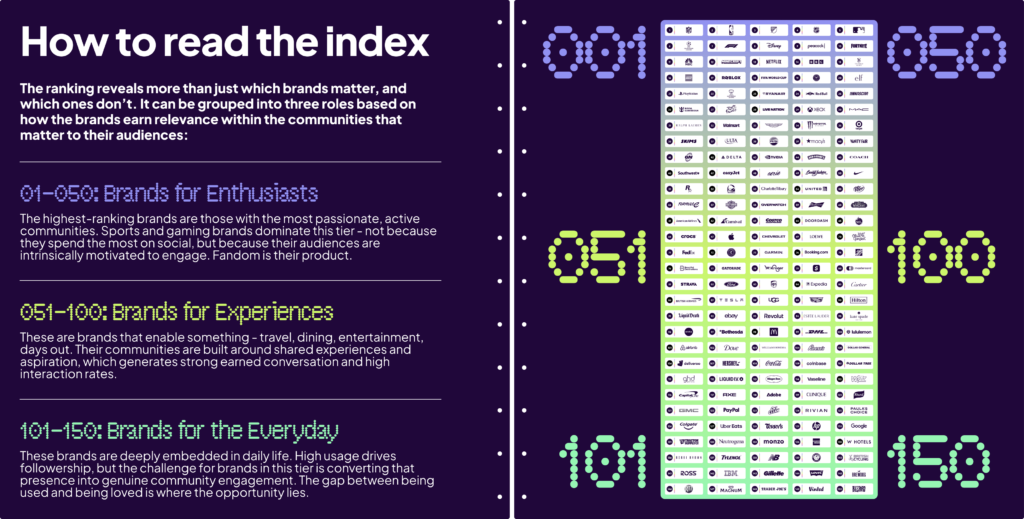
Brand Currency Index™ 2026
Fandom brands often sit high in the rankings. Fandom is not a casual relationship. Fans organise time, money, identity and social behaviour around the thing they follow. They wear it, quote it, defend it, debate it and use it to find other people like them.
A sports fan is not just a customer. A gamer is not just a user. A music fan is not just a ticket buyer. These identities travel. They give people an easy way to say something about themselves.
That is currency.
The same logic applies beyond pure fandom. Some brands create parts of our social narrative. Brands like Netflix #13 and Disney #8 give people subjects to gather around. A series launch, a documentary, a cultural flashpoint, a product drop, a live moment, a controversy, a shared national joke. These brands become topics.
Others create moments (Wimbledon #19, Booking.com #74). They help people turn real-world experiences into memories, proof and participation. Travel, leisure and entertainment brands often benefit here because their products happen in life, not just on screens. The online layer matters because it makes those moments visible, shareable and repeatable.
This is why Brand Currency should not be read as a narrow measure of social media performance. It is a way to understand how brands move through the visible traces of community behaviour.
Social platforms did not invent belonging, status, storytelling, recommendation or imitation. They made more of it observable. The valuable thing is not the platform. The valuable thing is the behaviour and the strongest brands understand the behaviour they are part of.
Fame needs somewhere to move
None of this means fame has stopped mattering.
Reach still matters. Distinctiveness still matters. Creativity still matters. Memory still matters. Consistency still matters. Big communications still do a job. They create awareness, signal quality, build mental availability and give brands the scale they need to grow.
A brand with no fame has a harder job, but fame still needs somewhere to exist.
Awareness becomes more powerful when people can use it. Distinctive assets become more valuable when they attach to interactions people want to share. Creativity works harder when it creates material that travels through communities, rather than sitting inside a campaign report.
A brand can still buy reach. What it cannot buy so easily is a place in the interactions which move between people.
That is why famous brands can still underperform on Brand Currency. Their fame may be real, but inert. People know them. People may even buy them. But they do not use them to participate.
This is especially challenging for brands in functional categories. Finance, healthcare, logistics, insurance, utilities, education, property and many areas of consumer electronics can all be valuable, necessary and large. They solve problems. They enable life. They may even be trusted.
But necessity does not automatically create currency.
A brand that solves a problem may disappear the moment the problem is solved. A brand that enables a transaction may be forgotten as soon as the transaction ends. A brand that operates smoothly may become invisible by design.
For some categories, that may be acceptable. For others, it is a missed opportunity.
The question is whether a brand understands the kind of currency its category can credibly create.
For some, that might be expertise. For others, reassurance. For others, humour, responsiveness, access, usefulness, status, reliability, taste, identity or proof of participation.
The best brands know the difference between copying another category’s behaviour and finding their own terms of exchange.
What can people do with your brand?
Every category has unwritten rules.
People give different kinds of permission to different kinds of brands. They expect different behaviours from a sports league, a supermarket, a bank, a travel company, a gaming title, a broadcaster or a cosmetics brand.
These expectations shape what a brand can credibly do.
A sports brand can ask for devotion. A utility brand probably cannot. A streaming platform can post constantly about stories, characters and moments. An insurance brand needs a better reason to appear in someone’s day. A fast-food brand can use humour and appetite. A healthcare brand needs care, clarity and trust.
The brands with stronger currency understand those rules. Then they decide whether to follow them, stretch them or break them.
There is no universal social playbook. There is no single content formula. There is no one correct way to participate…
…except the one which reflects your brand’s positioning appropriately, within the communities which matter to your customers.
Brand Currency rewards clarity of role. It rewards brands that understand the shape of their currency, the community around them and make deliberate choices about how to move within it.
That reflection is what generates some discomfort from Social Element’s Brand Currency Index.
It challenges the assumption that fame, scale and awareness automatically translate into community value. It asks marketers to look at their brands through the lives of customers, not the architecture of media plans.
The brands that matter most are not the brands people know best, they’re the ones with the strongest currency.
Some famous brands will feel uneasy about that.
That is why the ranking matters.
You May Also Like

Design Is Britain’s Unsung Hero. It’s Time We Said So.
The UK design economy is worth £136.7bn and growing almost twice as fast as the wider economy. So why are we still so bad at recognising its value?

Count Me In – The Case for Total TV
We know that television still fills the room. Ask almost any advertiser and they will tell you the audience is larger than ever, gathered around bigger, brighter TVs.

Research Designed for the Decisions Advertisers Make
Advertisers have more choices than ever when deciding where to invest their media budgets.