




Social Platforms Are Getting Dramatic – but Marketers Don’t Need to Follow Suit

By Aaron Goldman, CMO, Mediaocean
When the communication theorist Marshall McLuhan said, in 1964, that “the medium is the message,” he put into explicit terms something that marketers still grapple with: where you say something matters as much as what you say. Where does a brand’s audience show up, and where does it actually pay attention? How does the impact of a polished 30 second spot on broadcast television stack up against a 280 character tweet – or even that same 30 second spot – on the X platform?
Indeed, the medium has recently become the message far more literally, far more often than even McLuhan envisaged. Elon Musk’s takeover and subsequent rebranding of Twitter, followed by Meta’s launch of Threads to fill a space that X might yet vacate, have made the platforms which constitute one of modern advertising’s key mediums into a key story of the year in their own right (not to mention the potential cage match between Elon and Zuck).
The recent narrative of social media platforms has been dense, fast-moving, unpredictable, and often hyperbolic, perhaps leaving marketers feeling like they need a fortune teller, seer, or psychic to make good, future-proofed decisions around them. But I think that there’s a good way to look at and understand this space even if you don’t have access to a – well, to a medium.
The social media map and marketer compass
A successful social media platform is a delicate ecosystem. It needs mechanisms to incentivise content creation and make consuming that content an engaging experience; it needs algorithms that connect people together while giving those people agency over who they are connected with; it needs effective moderation and oversight that does not add excessive friction; and making even small changes to those variables can have huge consequences on people’s perceptions and whether or not they use it. It’s small wonder that something like the announcement that X would be removing its block feature set off a firestorm of debate.
There is a trap, though, in marketers investing in analysis that the platforms must do for themselves: ultimately, it’s on X and Meta – alongside TikTok, Snap. Pinterest, Reddit, LinkedIn, et al – to refine and innovate the delicate instruments which keep them ticking. Successful marketers, meanwhile, need to tune their dial to the realities of those platforms from the perspective of brand-building and business outcomes.
We can think of the core dynamic of the contemporary social landscape as being about two key decisions. First, is the platform prioritising video or text? This dictates much about what kinds of interactions people have, from being conversational and news-oriented to being closer to a lean-back entertainment paradigm. Second, is that content’s discoverability structured around followers or algorithms? This informs how personal or public a space might feel and, therefore, what people are willing to use it for and how open they are to brand intrusion.
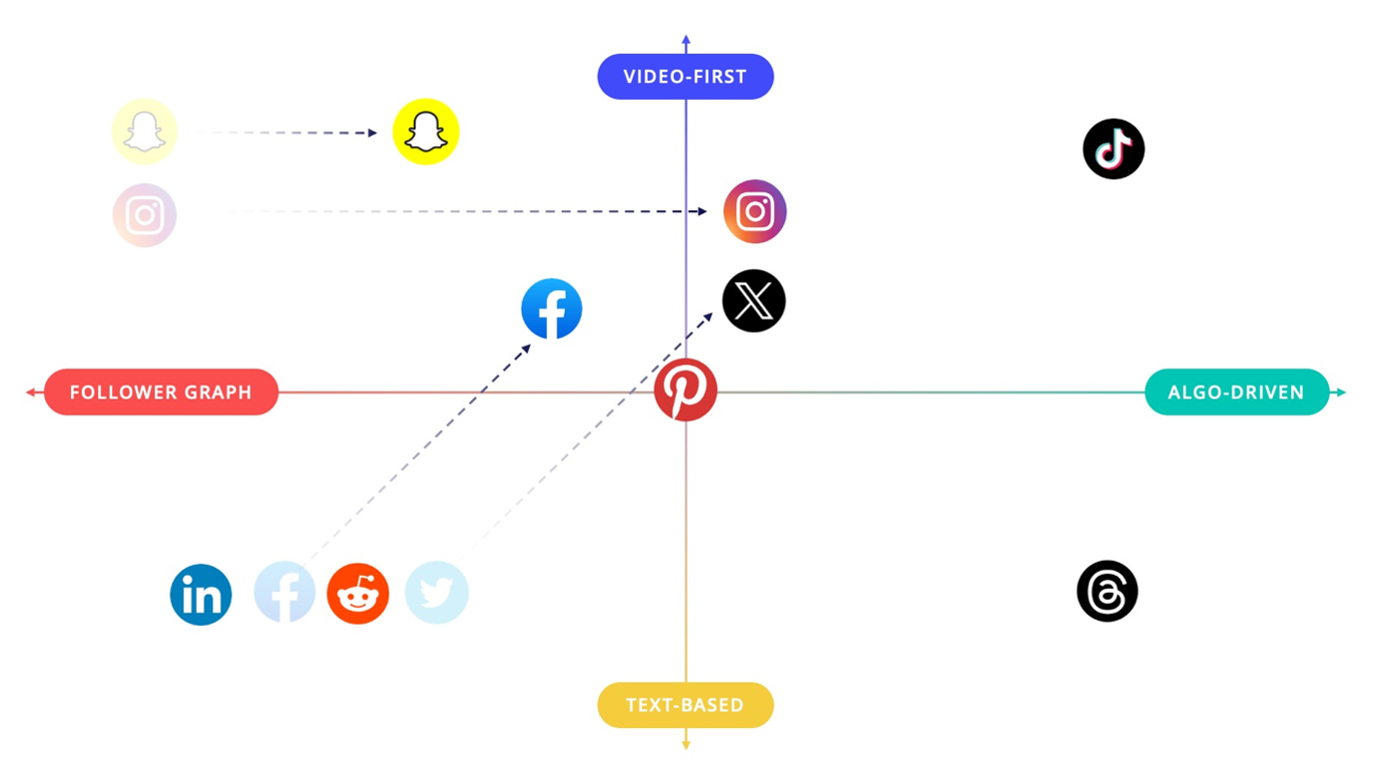
It’s a simple model, but it explains a lot about how social media platforms position themselves and how marketers can leverage them. Note, for instance, how the visuals-heavy Instagram has drifted towards an algorithmic model, as Facebook has become less reliant on text, creating more full-funnel opportunities for brands to take a cross-app portfolio approach through a wide-range of ad formats.
It also provides a framework for thinking about the recent dramas in this space. It becomes obvious, in these terms, that Threads is a play for the text-based section of the market which is increasingly underserved as others, including X, place greater emphasis on video – albeit it with an algorithmic approach to discovery which mirrors TikTok’s.
X marks the spot
If Meta’s strategy with Threads looks clear-cut, though, what are we to make of X itself?
By Musk’s own account, the path forward for X is to fly off the social media map altogether. He has often spoken of his vision of a Western ‘everything app’ to mirror services like China’s WeChat, bringing social interaction together with services like shopping, payments, gaming, and productivity under one roof.
Regardless of how that ultimately pans out – and there are many possibilities – two things seem certain. First, advertising is the platform’s traditional bread and butter, and it seems unlikely that additional services will erode the attractiveness of the platform as a marketing destination. If anything, more utilities like shopping and payments will give X more signals for advertisers to use with audience targeting. Second, the ongoing transformation of X will send waves through the social media space, and we should expect others to react, move into emerging white space, and mimic successful new features as necessary.
From this loftier vantage point, out of the weeds trying to follow the twists and turns of Musk, Zuck, and other tech leaders’ posturing, marketers need to play the full, shifting field of social media, not on playing catch up with any given platform’s evolution. That means being able to run bespoke video, text, and other assets, across all key platforms, without having to reinvent the wheel with your creative and activation strategy every time you do so. Independent ad tech stacks provide the ability to centralize campaign management and automate creative production so that it’s the marketer’s goals serving as the North Star rather that the parameters of each platform setting the course.
The medium is, after all, the message – and sizing up the social media map is no small task. You could say, heh, that’s it’s actually an X-L.
You May Also Like

From Prime Time to “Right Time”: 3 Shifts Redefining the Sports Marketing Playbook
As another fall sports season gets underway, marketers should look beyond the biggest moments on the calendar without losing sight of their power.
AI is Winning the Race but Losing the Room
Winning the race is one thing. Bringing the room with you is another.

Your Advertiser Has a Question. You Have a Study.
Retail media taught buyers to expect an answer to the thing they actually asked. Most sellers can still only offer a subscription.