




What if the problem with the agency model isn’t whether an agency is independent or owned by a holding company, but the shape of the agency itself?
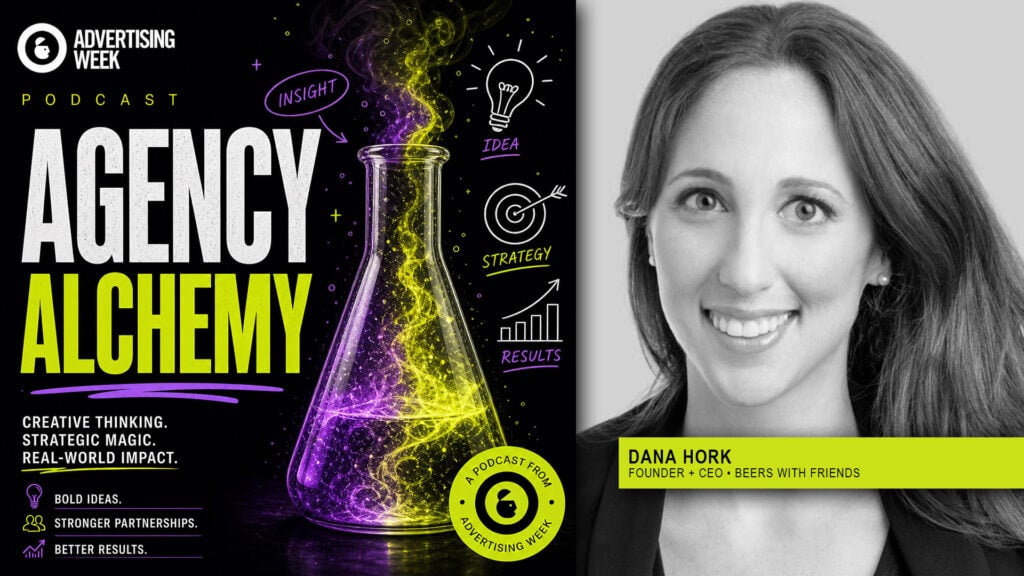
Dana Hork, Founder and CEO of Beers with Friends, joins Agency Alchemy to explain why her “microagency” operates with just two full-time employees, builds bespoke teams of fractional specialists around individual client problems and uses tightly constrained five-day creative sprints to eliminate much of the bureaucracy associated with traditional agency relationships.
We discuss why speed is really a product of alignment, why agencies should stop staffing accounts based on who happens to be available, how identifying a single client decision-maker can dramatically improve the creative process and why collaboration works better when clients are brought inside the process rather than presented with polished ideas at the end.
We also explore AI’s role in this emerging agency model, including why Hork sees it as an enabler rather than a replacement for creative talent, how it can create “shared consciousness” between agencies and clients, and why a world in which AI makes “good enough” essentially free could make genuinely differentiated human thinking more valuable than ever.
Five Key Takeaways
1. The next agency model may be about shape, not size.
The traditional distinction between large holding-company agencies and smaller independents misses a potentially more important evolution. Beers with Friends operates with two full-time employees and assembles fractional specialists around each assignment, creating an agency whose capabilities can expand, contract and change according to the problem rather than the organizational chart.
2. Speed is ultimately an alignment problem.
Five-day sprints create useful constraints, but Hork argues that the real reason the model moves quickly is because it forces agencies and clients to align around objectives, stakeholders, timelines and decision-making. Much of what agencies experience as slow creative development is actually organizational ambiguity disguised as process.
3. Staff the problem, not the agency.
Traditional agencies inevitably have an incentive to deploy the people already sitting inside the organization, whether or not they represent the perfect combination of expertise for a particular assignment. A fractional model reverses that equation by defining the problem first and assembling what Hork describes as the right “SWAT team” rather than automatically sending in the army.
4. AI makes “good enough” cheap, which makes differentiation expensive.
Hork sees AI primarily as an enabler, particularly for productivity and rapidly visualizing early creative thinking rather than replacing human creativity. Its larger consequence may be economic: when competent, acceptable work becomes extraordinarily easy to produce, clients have less reason to pay agencies for execution and considerably more reason to pay them for ideas, judgment and differentiation.
5. Better agency relationships require less mind reading.
One of the simplest principles behind the Beers with Friends model is also one of the most consequential: explicitly establish who makes the final decision, bring stakeholders into the process and ask direct questions instead of interpreting layers of feedback. Removing ambiguity can eliminate enormous amounts of agency-client friction without requiring another platform, process or piece of technology.
Listen to all episodes on your favorite podcast platform: