


Why Your Ideas Need To Be More “Meme”

By Hernán Cerdeiro, CCO Americas, SAMY
Ever feel like you are drowning in an ever-deeper ocean of content?
Every time we open a social media app, we are met with creators, brands, friends, trends, news, memes, AI Cat in Hat videos, influencers and clips from your favourite podcast. All fighting for the same eyeballs, fed to us constantly through personalised algorithms, across multiple channels and formats.
How have marketers responded? More content. Add to the noise. Spray and pray. Something will stick, right? More attempts to try and keep up with the algorithm in a bid to stay visible across every single platform and conversation.
But volume isn’t the answer to this volume problem.
In this sea of content, brands shouldn’t be looking to appear more often. Instead, they need to be creating something distinct and clear enough to be recognised and connect wherever it appears.
That doesn’t mean using the same execution everywhere. TikTok is not Instagram. Each platform has its own behaviours, quirks, language and communities. The real challenge is to create a brand idea that is strong enough to hold all those different expressions together without forcing them to sound or look the same.
And the best model for this approach? The humble meme.
Be More Meme
Simplicity is at the heart of every good idea.
That doesn’t mean basic thinking. In fact, creating something simple is often harder than making something complicated. It requires you to remove everything that gets in the way. Cut through the fluff, trim the fat, get out of the trees and then the central idea becomes impossible to miss.
Which brings us to the foundation of internet culture – the meme.
A meme rarely looks the same twice. The image changes. The caption changes. The cultural reference shifts. One community picks it up from another and gives it an entirely new context. Yet everyone still understands the joke.
But despite this endless adaptability, the meaning of the meme remains the same. This is not about brands becoming a meme account or just jumping on the latest viral meme. You don’t want to be that brand.
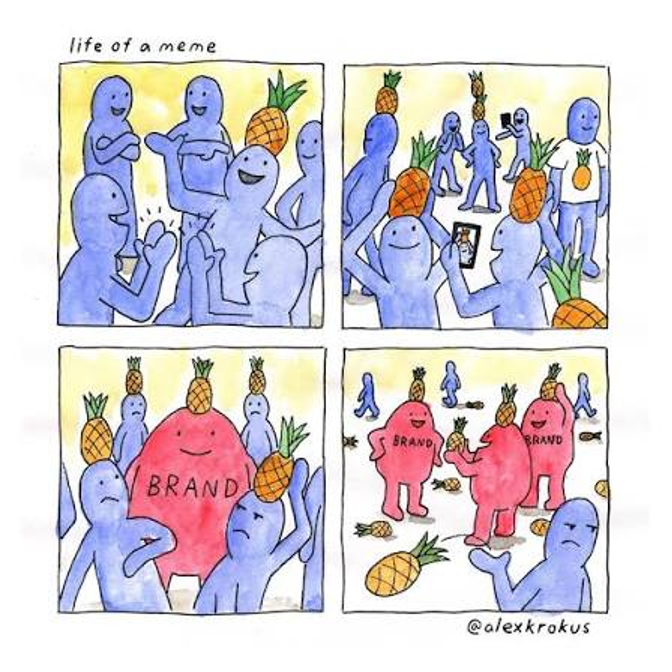
What this means is that you need to build an idea that is malleable, that can change without losing its identity. Something simple enough that can be recognised immediately but “open” enough for creators and communities to interpret in their own language.
It’s this consistency at the heart of the idea that is vital in this time of endless content. It’s not a set of rigid brand guidelines that stunts creativity or a master asset awkwardly resized for every channel.
People don’t have the time or, truth be told, the inclination to solve a puzzle every time branded content appears in their feed. Their thumbs are speed-scrolling across the digital universe. They are multiscreening, surrounded by distractions and moving between conversations that have their own references and rules.
But have something simple, clear, it can change; then that idea has somewhere to go.
Ideas that can change shape
A strong idea has that red thread that runs through it. The DNA of it can be seen on a TikTok video, a creator collaboration and an out-of-home spot. All connected. All recognisable.
Creators should be able to interpret it, while communities should be able to respond to it. People should be able to quote it, remix it or create something that the brand had never seen coming. When the idea begins to take on its own life, you know that you are onto something.
But that is only possible if the brand gives people something clear to work with. Participation is not the replacement for a vague, half-baked idea. If that central thought means nothing, then every new version of it takes it further away from the original. It becomes muddled and ultimately lost.
That’s why the strongest ideas have that simple and recognisable premise, but then leave enough room for others to get involved. Each expression can feel natural to the creator, platform or community while still adding to the same body of brand meaning.
As the old adage goes: “Keep it simple, stupid”.
You May Also Like
Emma Witkowski, VP, Media Solutions at WildBrain
Why Gen Alpha deserves marketers’ attention now and why branded content can earn attention by becoming part of the entertainment families already love.
Live Nation Backs New Creator-Economy Company Creator Nation
Live Nation is expanding its involvement in the creator economy, backing a new company designed to acquire, support and scale creator-management firms and adjacent businesses.
The Programmatic Stack Has Become Too Complex. AI Could Finally Simplify It
For three decades, digital advertising has added technology layers in the name of efficiency. The result is a programmatic ecosystem that can be remarkably sophisticated — and remarkably inefficient.