




For Advertising Week Executives, Preparation Starts With Setting Priorities

Three executives describe how they organize their thinking ahead of Advertising Week New York, with the Kindle Scribe serving as a tool for notes, planning and revisions.
Preparing for Advertising Week New York 2026 means deciding where to focus before the week begins. For executives balancing their own schedules with the needs of their teams, that involves setting priorities early while leaving room for new ideas and last-minute changes.
Mimi Swain, chief marketing officer of Amazon Devices and Services, puts time to think at the center of that process. “When I’m trying to consider what matters most for my team at Advertising Week, I need space to actually think,” Swain says in a video featuring executives from Amazon, Mekanism and Advertising Week.
Her approach reflects a challenge shared by the other participants: how to turn a busy industry gathering into time well spent. For Swain, that includes seeking inspiration and perspectives beyond the demands of daily business. For Jason Harris, co-founder and CEO of Mekanism, it starts with an itinerary and a clear intention for each day. For Ruth Mortimer, global president of Advertising Week, it requires keeping session material open to revision as news develops.
The Kindle Scribe runs through those preparation routines as the executives use it to write notes, mark up material and review information. Their comments focus on the decisions behind that work, while the footage shows where the device fits into it.
Harris begins planning a couple of weeks ahead. Alongside running an agency, he hosts a podcast and writes on Substack—responsibilities that shape what he hopes to accomplish at the event. “Advertising Week is the most condensed period of networking and learning in the year,” he says. “I really try to game plan that itinerary ahead of time.”
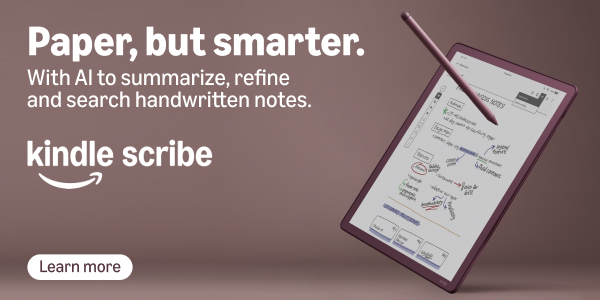
That planning gives each day a purpose before competing demands take over. Harris describes sketching out his itinerary and setting an intention for what he wants to accomplish. His use of the Scribe includes taking handwritten notes and selecting its “Summarize” function, with the resulting display organizing material under the heading “Core Values and Principles.” The sequence illustrates a step between recording thoughts and reviewing them, though it does not establish a measurable effect on productivity.
For Mortimer, the central concern is keeping preparation current. An event built around industry conversations must be able to address developments that emerge after a script has been drafted. “Often we’re doing sessions about things that are happening right then in the news that very morning,” she says. “So it’s really important that our scripts are living documents.”
Mortimer is shown annotating a script on the Scribe, adding handwritten notes alongside the text. Her comments underscore why that revision process matters: preparing a session includes making room for information that could change the discussion.
Swain’s approach adds another consideration. Choosing what to attend also means preserving opportunities to learn something unexpected. She reviews and marks a session listing on the device, linking her broader emphasis on reflection to the practical task of deciding where to spend time.
The three executives describe preparation as an ongoing process of choosing, reviewing and adjusting, with the Scribe providing a place for work ranging from early handwritten thoughts to revisions closer to the event. Their priorities offer a broader lesson for attendees heading into Advertising Week: know what you want to accomplish, but leave enough room for the week to challenge what you already think.
You May Also Like

How to Find Authentic Experts in a World of Ai-Generated Content
As AI-generated content floods the internet, how do we know who’s actually an expert anymore? Why businesses need better ways to distinguish genuine human expertise from AI-generated noise.

Brands Can Scale Creator Content Without Sacrificing Authenticity
With platforms and technology providers promising easier discovery, faster campaign setup, and more efficient distribution, creator marketing is starting to look more like the rest of digital advertising. For brands managing a growing number of creator relationships and assets, the appeal is obvious. But it also raises a reasonable concern.
Design Is Britain’s Unsung Hero. It’s Time We Said So.
The UK design economy is worth £136.7bn and growing almost twice as fast as the wider economy. So why are we still so bad at recognising its value?