


An AI Writing Brief Needs Facts That Cannot Change

By Bernie Grohsman, Morpheus Consulting Inc.
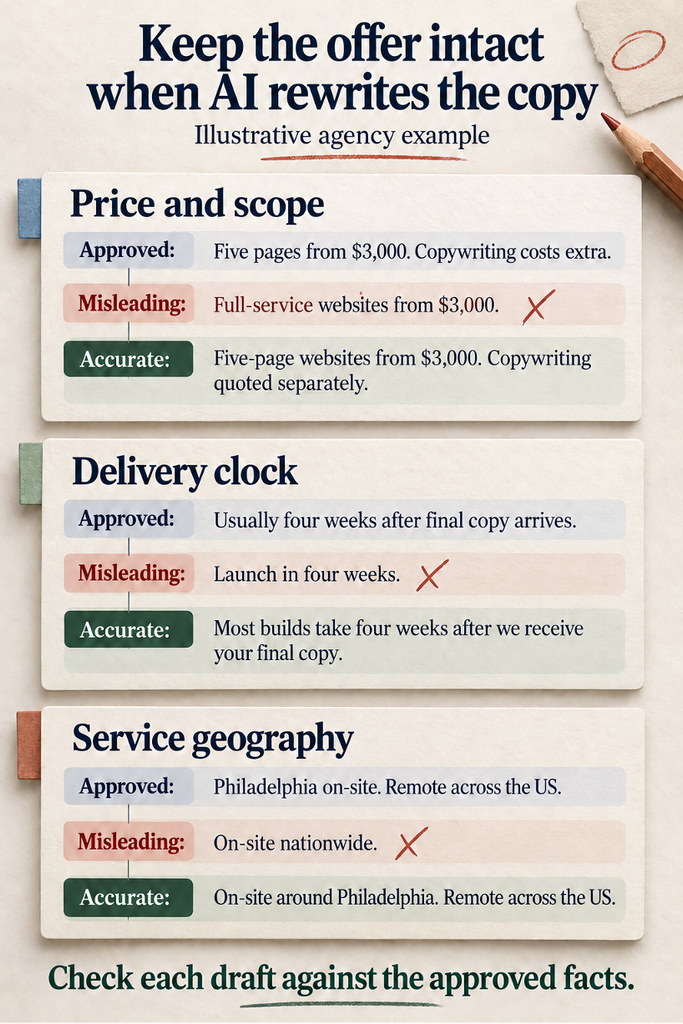
Imagine asking AI to make an agency’s website offer more compelling. In this hypothetical example, projects start at $3,000 for five pages, copywriting costs extra, and the build usually takes four weeks after the client supplies final copy. On-site work is available around Philadelphia, with remote projects elsewhere in the United States.
An invented draft reads: “Full-service websites nationwide, from $3,000. Launch in four weeks.”
It sounds ready. But the price now appears to cover everything, the delivery clock has lost its starting point, and “nationwide” leaves the on-site arrangement unclear. A customer could read the sentence perfectly and still misunderstand the offer.
That is why an AI writing brief needs a short list of facts the rewrite must preserve. Tone instructions help shape the language. They cannot tell the tool which qualifications carry the business’s actual promise unless we supply them.
Separate the offer from the phrasing
Before rewriting, record the facts that would change someone’s decision to inquire or buy. For our imaginary agency, the price must travel with the five-page scope and the copywriting exclusion. The four-week estimate must travel with the requirement for final copy. The service area needs to distinguish on-site work from remote work.
Company history belongs here, too. A founder who has worked in SEO since 2005 does not give an agency founded in 2019 a twenty-year operating history. Both facts can be persuasive without becoming interchangeable.
Keep this sheet small enough that someone will use it. Beside each fact, identify who approved it and where the current detail came from: a service specification, pricing document, or confirmation from the business owner. Include the date checked so the next writer can tell whether the information needs another look.
Then decide what the writer can change. The AI can suggest a livelier introduction or replace a vague adjective with a concrete explanation. It can reorder the page. It needs approval before it changes the scope of the offer.
Keep the qualifications close to the promise
“Make this shorter and more confident” leaves something important unsaid when shortening can remove the condition that makes a claim true.
A better instruction names the boundary: “Keep the starting price attached to its included scope. Preserve when the delivery clock begins. Do not expand the service area. If a fact is missing or conflicts with another source, flag it for review.”
That still leaves room for good writing. The accurate version of our hypothetical offer could say: “Five-page websites from $3,000, with copywriting quoted separately. Most builds take four weeks after we receive your final copy. We work on-site around Philadelphia and remotely across the US.”
It is longer, but each sentence helps the customer understand what they are buying. If space is tight, choose which promise belongs in that placement. Trying to squeeze the whole offer into a tiny headline may simply be the wrong assignment. Give the reader a clear route to the details they need before deciding to contact you.
The FTC’s advertising guidance requires truthful, supported claims. A more engaging sentence does not make its new promise any easier to substantiate.
Give revisions a factual review
Read the revised copy against the approved sheet before polishing it again. For every price, ask what it includes. For every timeframe, ask when it starts. For every experience claim, ask whose experience is being described.
Read the claim as a whole. The number might be unchanged while the words around it create a different expectation. “Four weeks” is still four weeks, but “launch in four weeks” and “four weeks after final copy” describe different commitments.
Ask the AI to list the factual claims it changed, then use that list to guide your own comparison. The draft and its self-review come from the same tool. A missed qualification can survive both.
When a change looks useful, take it to the person who owns the fact. Perhaps the agency now includes copywriting, or can deliver faster. If so, update the approved offer. A writing task should not make that business decision accidentally.
Update the brief when the business changes
Facts that must survive a rewrite can still change in the business. A protected starting price becomes misleading when it is out of date.
When the owner approves a change, update the sheet and check the places where the old promise was reused. The website may be correct while an ad or sales deck still quotes the previous price. An infographic needs the same review as a paragraph.
Start with one important service page. Put the facts that would affect a customer’s decision on a single sheet, then compare the next draft with it. The goal is useful copy that lets customers understand the offer the business is actually prepared to deliver.
About the author:
Bernie Grohsman has 26+ years of hands-on SEO experience and founded Morpheus Consulting Inc. in 2018. Morpheus helps service organizations with SEO, paid search, AEO/GEO, website design, and performance measurement.
You May Also Like
Let Creators Cook: Barstool’s MB Gambke on Turning Fan Trust into Brand Love
Recorded live at AWNY 2026, Rick sits down with Barstool Sports’ SVP, Partnerships & Marketing, MB Gambke to explore how trusted personalities, passionate communities, and fast-moving partnerships bring brands into the conversation.

Navigating a $1.34 Trillion Market: Scale, Automation, and Sourcing Real Value
The latest WARC Media Global Ad Spend report forecasts a global advertising market of $1.34 trillion, up 11.9%.

Rethinking Gaming Marketing, Featuring Mike Murphy O’Reilly, Chief Revenue Officer of Dexerto
Mike Murphy O’Reilly, Chief Revenue Officer of Dexerto discusses why gaming demands a more sophisticated marketing strategy than simply sponsoring esports teams, partnering with streamers, or building branded experiences inside popular games.