




Advertising Trends to Watch in 2023

By Stephanie Bunnell (Klimaszewski), SVP of Marketing at Aki Technologies, an Inmar Intelligence Company
You couldn’t attend an advertising or technology conference in 2022 without sensing the growing buzz around topics including the metaverse, Gen Z and NFTs. Focusing on the role these topics will play in the year ahead, here’s where marketing leaders should pay close attention.
Next-Gen Loyalty via NFTs
In 2023, we’re heading into an economic climate of brand-switching as consumers favor affordability. Paired with the overall decline in traditional print circulars and coupon-clipping as Gen Z’s spending power grows, expect brands to invest more heavily in Gen Z loyalty.
What will work? Brands seeking Gen Z loyalty must appeal to Gen Z’s waning attention span and authentically align with their values, ranging from self-expression to social impact.
“Living assets” may be one way to win Gen Z loyalty. For example, a living asset NFT would evolve in both design and value with each engagement. Imagine: A Gen Zer posts an NFT socially, which evolves it from 2D to 3D. Wearing it on one’s Roblox avatar for a day unlocks a discount. Wearing it for a week unlocks a donation to a purpose-driven cause.
By aligning with Gen Z’s digital identity and cause motivators, living assets are likely to gain popularity in 2023 as a loyalty solution that works for both consumers and marketers.
Metaverse Amplification
With growing interest in metaverse brand activtaions, “built-for-desktop” measurement will be challenged. Brands will need to favor time spent and high-quality engagements over impressions. At least, until critical mass can be achieved.
As marketers well know, you can build and experience but that doesn’t mean people will show up. In 2023, metaverse amplification investment will need to total double or triple a brand’s investment in metaverse production costs to actually get people there.
Mobile will continue to be the gateway to the metaverse and where brands will look for metaverse amplification opportunities. For example, Nike created a Snapchat lens that promoted Nikeland and Spotify created an in-app playlist promoting Spotify Island on Roblox.
AI-Generated Advertising Creative
AI platforms like Stable Diffusion and Midjourney have unlocked a new universe of capabilities for creators, while OpenAI and GPT-3.5 have commanded their share of recent headlines. Agencies like Publicis and Dentsu are leveraging AI for mood boards and brainstorming, yet, with reservations about brand safety, brands haven’t yet graduated to running fullly AI-generated advertisements, despite this having extensive future potential.
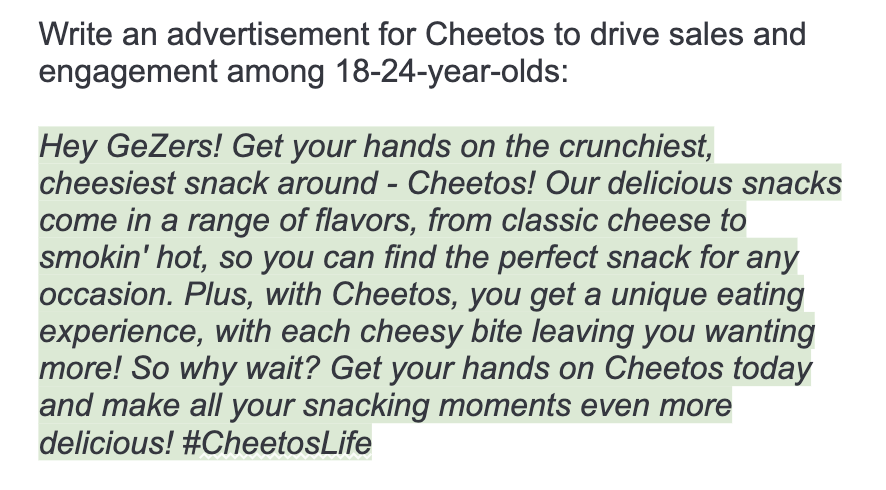
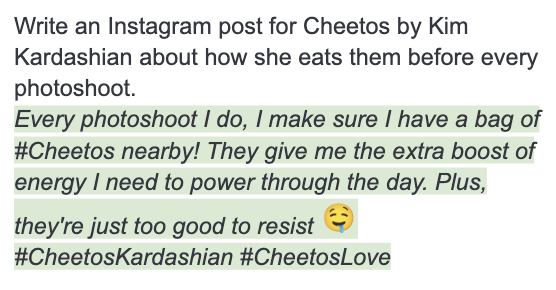
Currently, one can prompt OpenAI to “Write an advertisement for Cheetos to drive sales and engagement among 18-24-year-olds” or “Sell me on why Cheetos will make me more popular” or “Write an Instagram post for Cheetos by Kim Kardashian about how she eats them before every photoshoot.” The results are intelligently varied, as you can see:
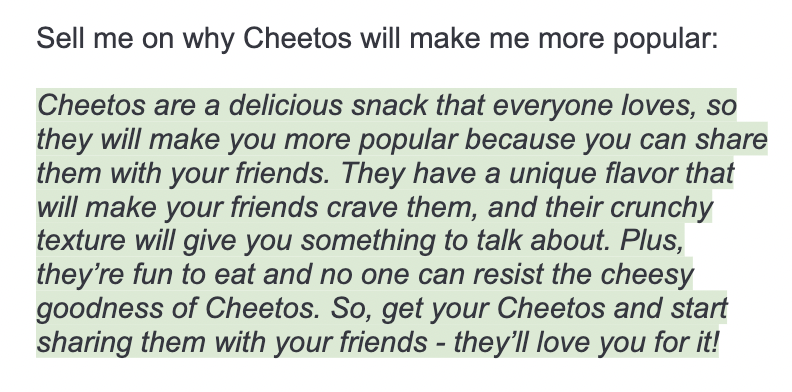
The novelty and convenience of AI is sure to drive new brand safeguards into AI algorithms and platforms in 2023. When brands are confident that the appropriate level of brand safety assurances are in place, they’ll lean into artificial intelligence to creative advertising with scale and with a relevance that was unimaginable before.
As 2023’s economic climate shifts and Gen Z’s spending power grows, brands will need to adapt and harness the loyalty-building power of NFTs, the increasing relevance of the metaverse and the untapped potential of AI. Marketing leaders should keep a close eye on these trends and consider how they can be incorporated into their strategies in order to capitalize on the top advertising technology innovation expected for the year ahead.
You May Also Like

Design Is Britain’s Unsung Hero. It’s Time We Said So.
The UK design economy is worth £136.7bn and growing almost twice as fast as the wider economy. So why are we still so bad at recognising its value?

Count Me In – The Case for Total TV
We know that television still fills the room. Ask almost any advertiser and they will tell you the audience is larger than ever, gathered around bigger, brighter TVs.

Research Designed for the Decisions Advertisers Make
Advertisers have more choices than ever when deciding where to invest their media budgets.