




Measuring AI Visibility in the Age of Generative Search

By Becky Johnson, Advertising Week Writer & Podcast Host
For years, marketers have relied on familiar signals to understand whether their brands were being discovered online. Rankings, clicks, impressions, and traffic have formed the backbone of search measurement. Generative AI has disrupted that model. When answers are created instead of simply retrieved, marketers are left asking a new question: what does visibility actually look like?
That question sits at the center of the work Caroline Giegerich, Vice President of AI at the IAB, is leading. Rather than building products or measurement platforms, the IAB is bringing together leaders from brands, publishers, agencies, platforms, and ad tech to develop practical frameworks that help the industry navigate AI.
The Challenge Isn’t a Lack of Data
One of the biggest hurdles with AI search is that it behaves differently than traditional search engines. Because large language models generate probabilistic responses, the same prompt can produce different answers each time. That makes consistency difficult and leaves marketers wondering what success should actually look like.
Instead of waiting for the market to settle, the IAB focused on defining what marketers should be measuring today. The result is the Four Ps of AI Visibility:
- Presence: Does your brand appear at all?
- Prominence: How visible is it within the response?
- Portrayal: Is your brand represented accurately and in the right context?
- Persuasion: Does the response encourage someone to learn more or take action?
The framework shifts the conversation beyond simple rankings. Visibility is no longer just about showing up. It’s about understanding how AI represents a brand and whether that representation creates meaningful business value.
Brands and Publishers Are Solving Different Problems
Although brands and publishers are both adapting to AI-driven discovery, their priorities are not identical.
Brands ultimately want consumers to visit their owned properties and make purchasing decisions. Publishers, meanwhile, are increasingly concerned with protecting and monetizing content as fewer users click through to their websites. Understanding citation weight and how content is surfaced by AI could become an important part of future licensing and monetization discussions.
The challenges are different, but both groups are adjusting to an ecosystem where AI increasingly becomes the first stop instead of a gateway to the open web.
Transparency Is Moving From Principle to Practice
As AI-generated creative becomes more common, disclosure has moved from a theoretical discussion to a practical one.
Giegerich explains that the IAB’s work centers on a simple principle: if AI has the potential to deceive a consumer, it should be disclosed. A fully synthetic avatar presented as a real person is one example where labeling helps preserve trust.
At the same time, regulation is rapidly evolving. New legislation and international regulations are beginning to establish legal requirements, making it even more important for marketers to understand both industry guidance and the regulatory landscape.
The Next Measurement Challenge Is Already Emerging
The conversation closes by looking beyond generative search toward AI agents.
As agent-driven traffic grows, long-standing advertising metrics based on human attention may become less straightforward. Impressions, clicks, and views were all built around human behavior. If AI agents increasingly search, evaluate, and gather information on behalf of consumers, marketers will need to rethink how those measurements evolve alongside them.
The technology will continue to change, but one theme remains consistent throughout the discussion. AI is creating new questions faster than the industry can answer them. Practical frameworks, informed by broad industry expertise, will be essential for helping marketers adapt as those questions continue to evolve.

You May Also Like

Stop Pitching and Start Building Featuring Laurel Burton of Instrument
Joining us is Laurel Burton, CEO of Instrument, a design and technology company whose work includes Nike, Oura, Google, and Nordstrom.
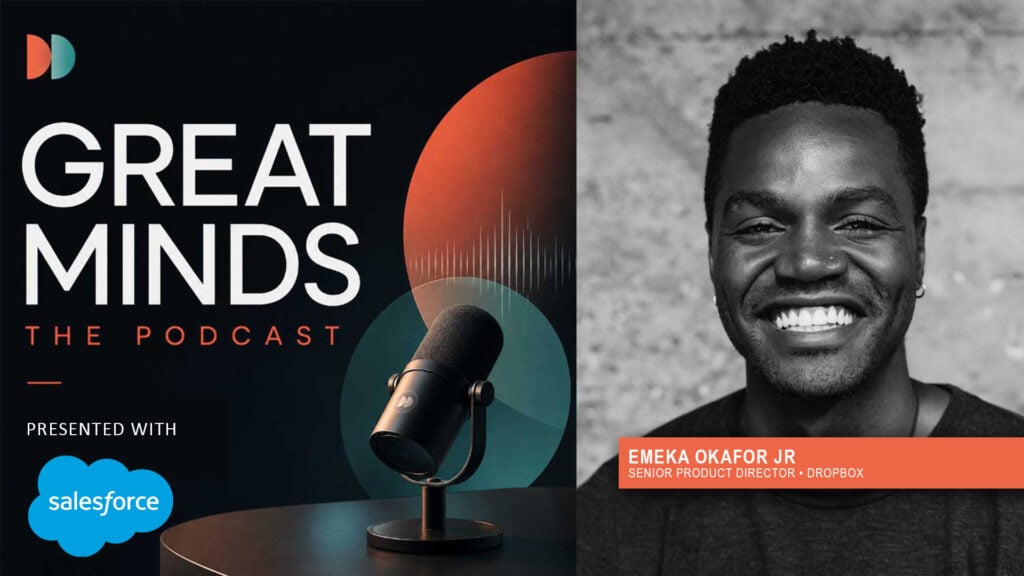
Customer-Led Products with Intentional Leadership Featuring Emeka Okafor Jr. of Dropbox
Joining us is Emeka Okafor Jr., Senior Product Director at Dropbox, who leads product for its applied AI division.

Podcaster Brinda Adhikari on Building Trust Through Curiosity, Not Correction
Brinda Adhikari, a journalist and the co-host of the podcast “Why Should I Trust You?,” joins host Drake Baer to discuss what it takes to build trust in science and public health across deep divides.