




Which Fast Food Fans Are Still Avoiding the Vaccines?
By Ericka Podesta McCoy, CMO,
Long gone are the days of brands sitting on the sidelines when it comes to the most important societal issues of the day. From political candidates to race issues to environmental activism, many consumers expect companies to take a stance on the topics that matter to them, and they reward the brands that reflect their personal values with fierce loyalty. Certain key segments of consumers expect brands to use their tremendous marketing power to benefit the greater good, and they socially engage and support brands that do.
As the Delta variant prompts COVID-19 resurgences around the world, the topic of vaccination remains a key concern within communities, putting the issue at the forefront of brand marketing agendas as well. A recent survey found that 6 out of 10 consumers think that brands have a responsibility to be encouraging COVID-19 vaccinations. Major brands, from Budweiser to Krispy Kreme, are stepping up to this challenge by offering incentives unique to their brands.
However, the delicate topic of vaccination perception means that there is no one-size-fits-all appropriate response for brands. The messaging and actions of a given brand must be crafted with the nuance of their audiences in mind, lest any marketing or promotions fall on deaf ears or—worse—alienate loyal customers on the receiving end.
To illustrate the vast differences among brand audiences on the topic of vaccination, even within a specific sub industry—Quick Serve Restaurants (QSRs), in this case—consumer insights and analytics firm Resonate recently tapped its Ignite Platform to examine how vaccine hesitancy and readiness varies among loyalists of top fast-food franchises. The results, visualized in the below snapshot, were illuminating.
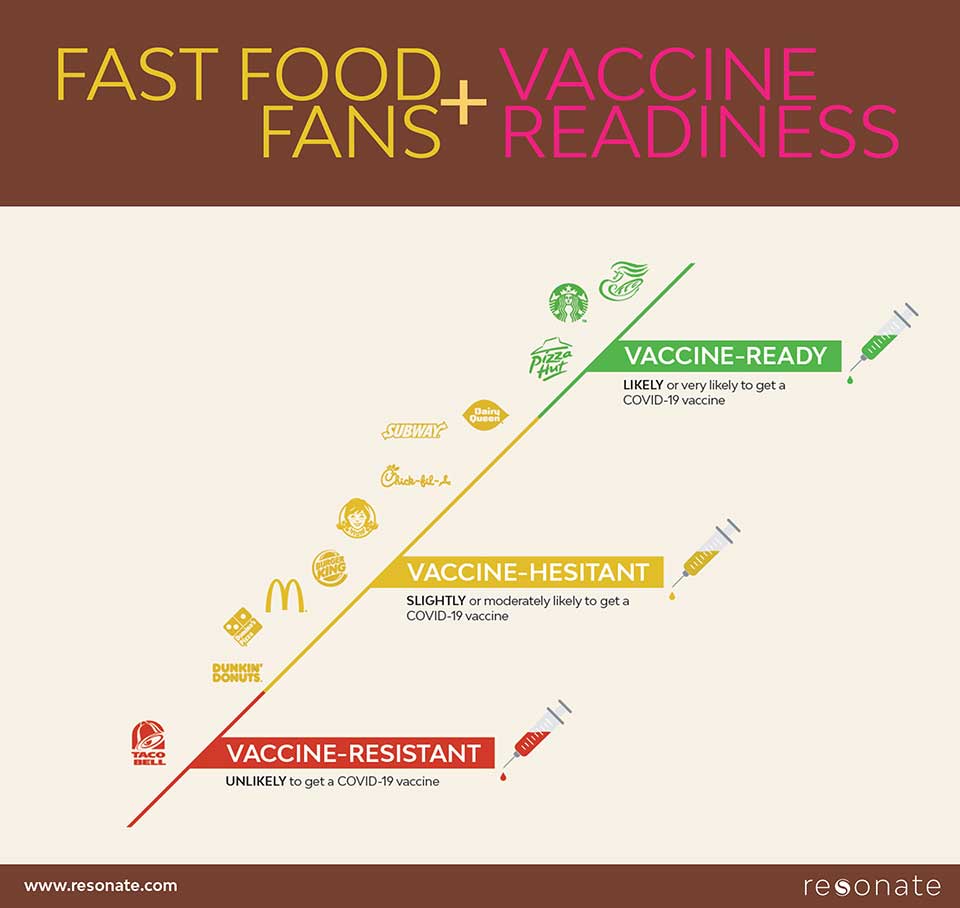
According to our proprietary insights, Panera, Starbucks, and Pizza Hut customers top the list when it comes to vaccine readiness, meaning these customers are the most likely to have already received a COVID-19 vaccine or to be actively seeking vaccination. Meanwhile, Taco Bell customers remain most resistant to vaccination.
The differences become even more striking when you consider how widely vaccine readiness varies among loyalists of different brands in the same QSR category. For example, Domino’s customers are notably lower on the vaccine readiness scale when compared to Pizza Hut customers, just as Dunkin’ customers are far less likely to receive the vaccine than Starbucks customers.
These audience differences—ones that fluctuate dynamically with the evolving market—must be understood if brands intend to build strategies that engage effectively on hot-button topics. Only through an intimate, up-to-date understanding of a given audience can marketers hope to connect in a meaningful way around sensitive issues such as vaccination.
Brands need to ensure their data-driven decision-making capabilities rise to the challenges posed by today’s climate of corporate responsibility. Audience expectations are high—and the stakes are even higher.
You May Also Like

Your Brief Is the Middle of the Story, Not the Start
Which conventions are worth keeping? What distinctiveness should you lean into? Where is there room to flex, or to break with convention?

Would Your Reddit Post Survive Its Own Subreddit?
Reddit’s had an interesting run lately and I think a lot of people have read it completely the wrong way round.
Measuring Beyond the First Sale Featuring Jerome Shimizu of ABCS Insights
Joining us is Jerome Shimizu, CEO of ABCS Insights, whose company takes its name from the four areas it measures: Audience, Brand, Consideration, and Sales. Jerome explains how ABCS applies the same measurement methodology across 16 marketing channels so advertisers can compare results consistently.