





Why Some Brands Matter, and Some Brands Don’t

Have you ever tried to prove the value of social – and found yourself reaching for metrics that don’t quite say what you mean? This article introduces the thinking behind Brand Currency: why the social industry has been asking the wrong questions of the right data, and what a better measure of brand value actually looks like. It is the first in a five-part series exploring the findings of the Brand Currency Index™ – a proprietary study by Social Element measuring the value of brands on social media.
By Victoria Hoyle, Global VP Intelligence, Social Element.
An introduction to Social Element’s Brand Currency.
For most of the history of social media as a marketing discipline, the industry has been asking the wrong questions of the right data.
When social intelligence first entered the building, the task was tactical: tracking sentiment, reporting volume, and monitoring mentions. The data was rich. The ability to explain what it meant commercially and strategically was not. This was listening, not intelligence.
The temptation was to solve that problem by forcing the data to do something it wasn’t designed to do: act as a proxy for business outcomes. To treat reach as if it were revenue. To call an audience a community. To build reporting that looked like proof, without quite being it.
That has changed. Brands are now committing serious investment to social. And with that shift has come a harder question: what, exactly, are we building – and how do we know if it’s working?
That was the question that started Brand Currency.
It also arrived at a particular moment. The conditions that made that question urgent when we began have only intensified. Third-party data has contracted. Reach has become less predictable. AI-generated content is flooding owned channels. And, platform fragmentation means a brand’s community might be distributed across multiple environments, each with its own norms, audiences, and dynamics.
In that context, the industry’s instinct has been to reach for more data, faster dashboards, broader listening – and access to AI to process it all at speed. What we needed instead was a clearer signal. Something that could tell a brand not just what was happening, but whether what was happening meant anything.
And so, we went looking for the relationship between social behaviour and brand value. The first thing we found was a clear absence. Metrics like posting frequency and raw reach had no meaningful link to brand value.
What does matter is community. Specifically, a brand’s ability to grow it, nurture it and give it reasons to keep interacting. That relationship between community strength and brand value is the foundation of everything in this study.
We want to be precise about what that means. This is not an econometrics study. We are not claiming attribution or arguing that social activity causes commercial outcomes in a straight line. The social world we’ve examined is shaped by TV campaigns, cultural timing, paid investment and brand history. We don’t pretend otherwise.
What we are saying is that the relationship is real. The strength of a brand’s social community is a meaningful signal.
Our Brand Currency Index™ is how we measure the strength of that community.
Every industry has unwritten rules for how brands and communities interact, in other words, a social contract. Audiences grant brands permission to show up in the spaces where they socialise. The strongest brands know how to work with those rules, and when to break them.
From studying 450+ brands across 16 industries, we’ve been able to reveal those rules. How well brands play by those rules is then reflected in how they score. It has enabled us to rank them within our Brand Currency Index™, to compare them, and to identify the community-building behaviours of the world’s most socially valuable brands.
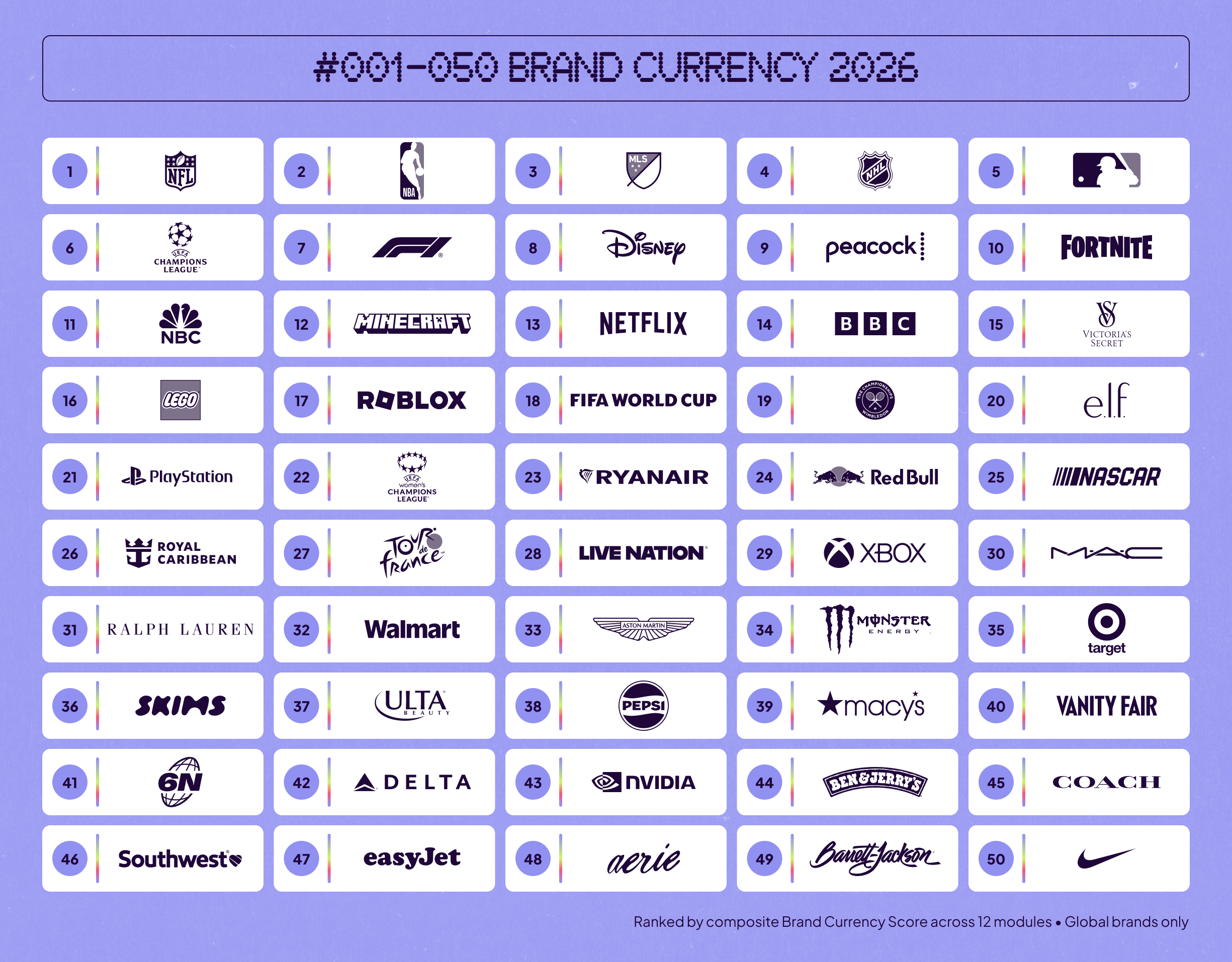
Brand Currency Index™ 2026
Yet, the most interesting part of this study isn’t the scores and how brands rank from first to last. It’s in the shape of how brands build currency.
The data revealed three distinct visible patterns, three ways that brands build relationships with communities and exchange value with them. Three Social Contracts of Brand Currency.
- Fandom. Brands that are part of communities people build identities around.
- Conversation. Brands that generate community discussion effortlessly.
- Moment. Brands tied to real-world experiences that show up online.
Not every brand falls cleanly into one of these. In fact, a significant portion of brands in the study operating in Finance, FMCG, and household categories don’t. They exist in what the data makes visible as a mass of mediocrity. Present in people’s lives, but not in their conversations. Neither building nor losing community, just occupying space. It is possible to be a well-known brand and have almost no social contract with the people who buy you.
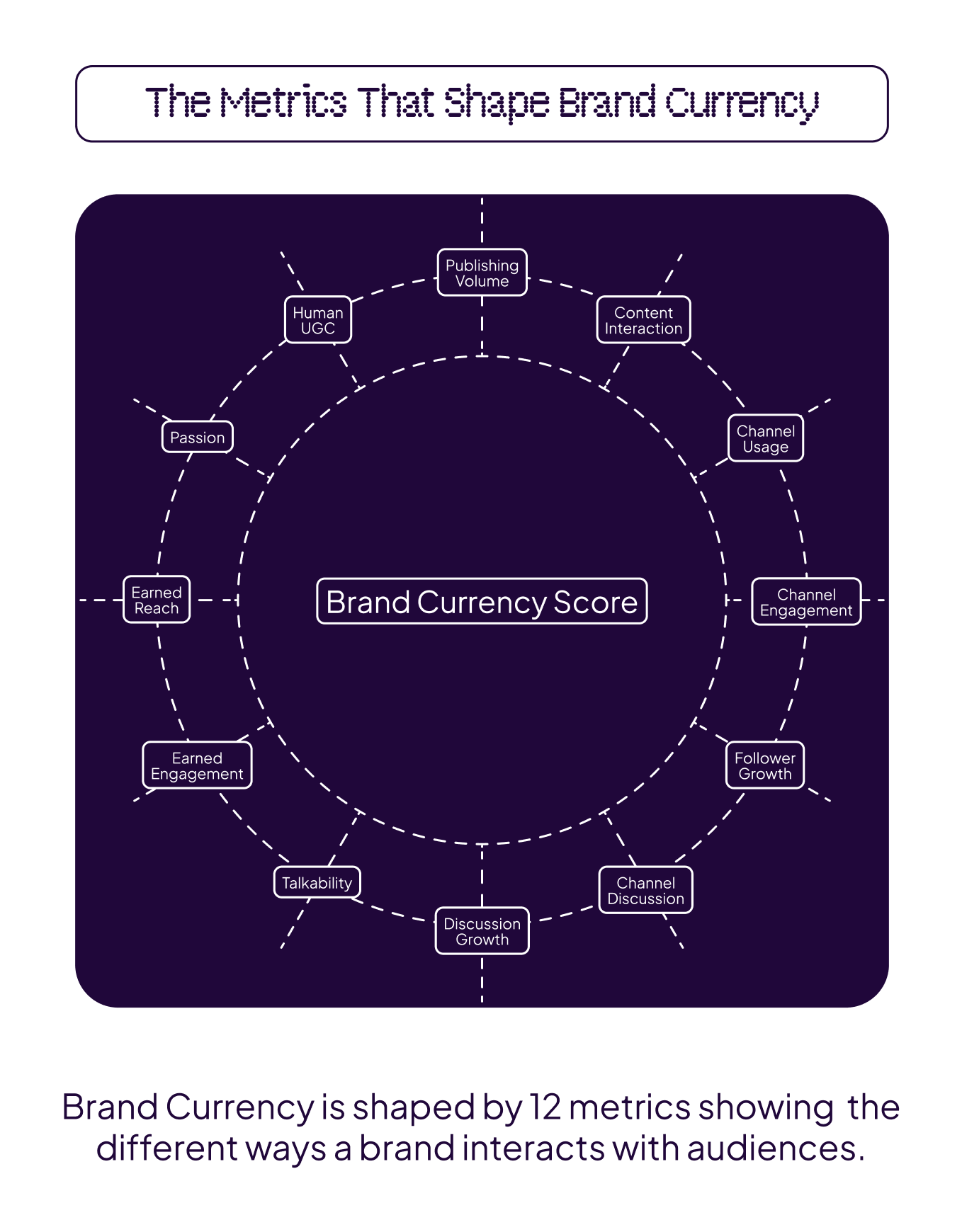
Brand Currency Index™ 2026
But the shapes and contracts to which brands belong are a starting point, not a ceiling. What the data also shows is that the most interesting brands don’t stay neatly inside one shape; they borrow behaviours from adjacent shapes to break out of the average mass. They understand the rules and when to break them. A Finance brand that finds its Moment. An FMCG brand that builds genuine Fandom. The Social Contract tells you where you are. What you do with it is a strategic choice.
The scores that come out of this study are best understood as a diagnostic. They tell you where you are relative to your category, your shape and contract, the brands that do it best – and worst.
They will tell you whether the community you’re building is the kind that holds, grows, and compounds over time. Whether you are moving toward something, or treading water.
That is, in my view, the right question to be asking of social data. Not measuring what this post did, but what kind of brand we are becoming in the places where people actually talk. Why some brands matter, and some brands don’t.
I’ve spent my career working across media, technology and creative agencies, and now social. In every room, the same question followed me: how do we prove what this is worth? Brand Currency is my best answer to date – and I know it is only the beginning. The relationship between community and commercial value will sharpen as the data does. But the belief underneath it has always been simple: the interactions between people and brands matter, and they deserve to be measured as if they do.
You May Also Like

The Entertainment Revolution: Why Brands Need to Think Beyond the Screen
As gaming, streaming and social media reshape how audiences experience entertainment, marketers face a fundamental challenge: Learning to participate in culture rather than simply advertise alongside it.

More Than the Game: Earning a Place in the Fan Conversation
Ann Piper, Head of Sales for the Americas at Spotify, moderated the discussion with Angela Steele, Chief Client Officer, U.S. at WPP Media; Wes Harris, Director of Marketing for YouTube TV at Google; and Juliet Litman, Director of Talent and Operations at Spotify Podcast Studios.

Traditional Attribution and Promo Codes Share the Same Blind Spot
Traditional attribution and promo codes share the same blind spot.