




Maximizing Your Marketing to Draw, Capture and Activate Attention

By Victoria Beyer, VP of Sales, West, Digital Turbine
The world is saturated with ads, and not even a variety of ads but the same ads over and over. With every new platform that appears, from digital out of home (DOOH) to virtual reality worlds and products to streaming services, brands see a new opportunity to deliver more of the same. Unfortunately for consumers, brands have resorted to serving up more ads in more places rather than focusing on the value exchange with consumers that provides them with the best ad experiences.
With so much saturation, consumers easily become blind to advertising and it’s harder for the brand’s message to have any meaningful impact. And although digital technology has helped marketers follow consumers around their daily lives, the means to track these individuals are going away. Which is why marketers are placing importance on attention metrics to provide vital insights so that brands can better understand meaningful interactions with advertisements.
How Attention Differs Across Media
On the surface, attention is simply a way to measure how much time a consumer spends with a piece of content. But the devil is in the details. To garner attention, marketers must pique a consumer’s interest, hold their interest and eventually lead them to a desired outcome. Taken even further, the level of attention can vary – does an ad have a consumer’s full attention (active attention), partial attention (passive attention) or no attention at all (non attention)?
Just consider how much attention you pay to an ad on TV, in your web browser or on your mobile phone. Using eye capture data and audience analysis, research firm Amplified Intelligence discovered that 76% of ads are dismissed within ½ a second. As a result, marketers are challenged with not only knowing where to advertise, but how to combat ad fatigue and ensure that consumers are actually seeing their message.
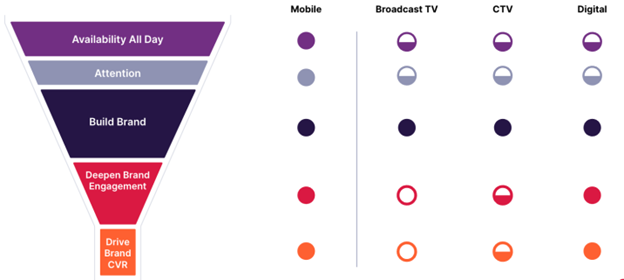
To understand how your ads are being seen and acted upon, consider how consumers interact with those ads and how the medium itself impacts attention. Not all promotional tactics are equal when it comes to garnering attention. Some, such as in-game advertising, CTV advertising and social media influencers excel in advancing attention, but they do so in different ways at different points in the brand funnel. Taken holistically, each can add value to a brand’s larger marketing mix.
But mobile is the only medium that can help drive brand goals throughout the entire funnel. While other mediums may have their place for advertising, mobile advertising (and particularly mobile games) is the only one that people engage in 24/7, in multiple ways and with multiple mindsets. This makes it the only all-purpose vehicle for brand advertising.
How Mobile Stands Apart for Attention
Consider how you use your mobile phone vs. how you might use your PC or TV. While a PC or TV might be stationary, your phone goes with you and is almost always in your hand or within reach. As our primary connection to the world, we use our phones to communicate, capture sights and sounds, search, entertain, and enrich and distract us, even when we’re bored. In this sense, we often use our phones in micro time increments, whereas we may use our PC or TV for longer periods of time and more purposefully to work or catch up on a show.
Mobile, however, is the true crossover. While people certainly will spend hours swiping through reels or even watching shows on their phone, it’s also our go-to device for killing time: playing a quick casual game, checking out the latest sport’s scores or seeing what friends and family are posting on social media.
Our phones are also the first thing we look at in the morning and the last thing we look at before bed at night. And although screen time can vary by age and other demographics, there has been a sustained increase in screen time since the COVID pandemic – we simply spend more time on our phones than ever. When you consider how many different activities we perform on our phones and the different mindsets that come with every one of them (boredom, curiosity, excitement), all these make our phones the prime spot for accomplishing ALL brand objectives.
For example, if you simply want to build awareness, you can use social campaigns to draw attention to your brand. If you’re looking to achieve deeper brand engagement, you can incorporate social media influencers and video storytelling to capture their attention when people are on TikTok, YouTube or playing video games. And finally, if you want to drive conversions or increase brand loyalty, you can activate that attention by adding interactive features to video ads or use contextual promotions or loyalty discounts in your display ads.
By understanding how users spend their time, engaging them at the most opportune moments and taking advantage of that attention, brands can create better ad experiences that benefit the brand and the consumer.
About the Author
Victoria Beyer has well over 23+ years of ad tech experience in mobile, programmatic, data, and complex technology covering Brand and DR strategies. She is a seasoned leader in sales and operations who builds teams that outperform peer sets in growth, efficiency, culture, and loyalty. Victoria has sold as both a market challenger and market leader, adjusting to the range of resources and challenges to gain maximum impact. She brings her experiences from working at the following companies: Conversant, Vivendi Universal Music, IAC Interactive, Millennial Media, and Quantcast.
You May Also Like

Podcaster Brinda Adhikari on Building Trust Through Curiosity, Not Correction
Brinda Adhikari, a journalist and the co-host of the podcast “Why Should I Trust You?,” joins host Drake Baer to discuss what it takes to build trust in science and public health across deep divides.
Add to Cart, Add to Culture: The Full-Funnel Commerce Evolution
Joining us is Abhay Singhal, co-founder and CEO of InMobi Advertising. Abhay explains what he means by agentic advertising and where early experiments with conversational ads are taking the industry.
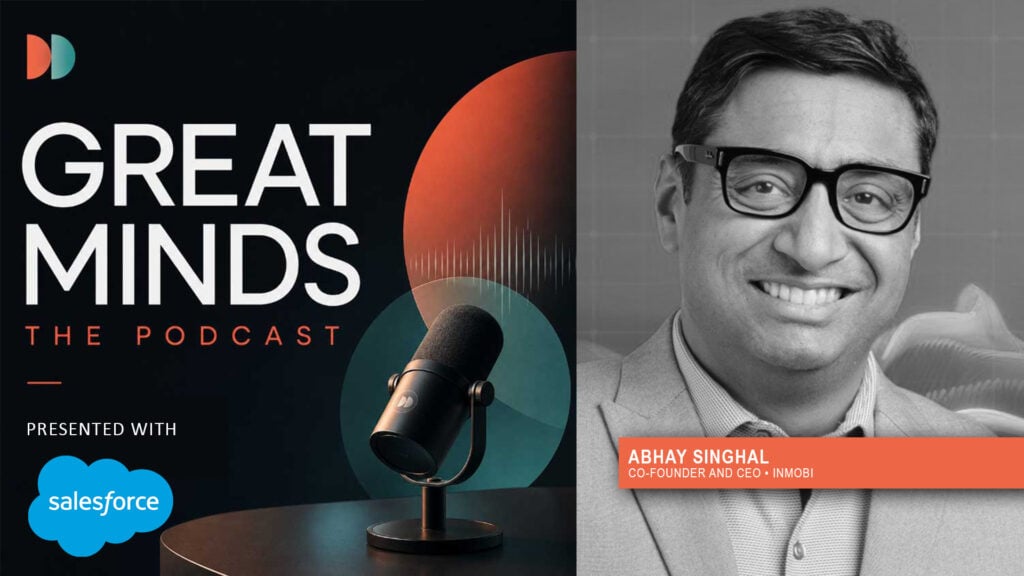
When the Customer Sends an Agent with Abhay Singhal of InMobi & InMobi Advertising
Joining us is Abhay Singhal, co-founder and CEO of InMobi Advertising. Abhay explains what he means by agentic advertising and where early experiments with conversational ads are taking the industry.