

By Chris Ciompi, Senior Partner, Lippincott, Marketing & Customer Strategy
CMOs, how often have you been asked by your boss or peers to help grow the company? It’s a common question – and one that rarely comes with an easy answer.
You craft a balanced plan – investing in both brand and performance marketing – only to see all brand investment cut in favor of performance marketing. Why? Because it’s easier to attribute ROI to performance marketing, while the impact of brand investment often feels intangible and elusive.
It’s an all-too-familiar struggle, but one that doesn’t have to persist year-over-year. Based on our research, surveying over 250,000 customers across 800+ brands over seven years, a clear pattern emerges: brands that build meaningful relationships with their customers grow 2-5x faster than their competitors.
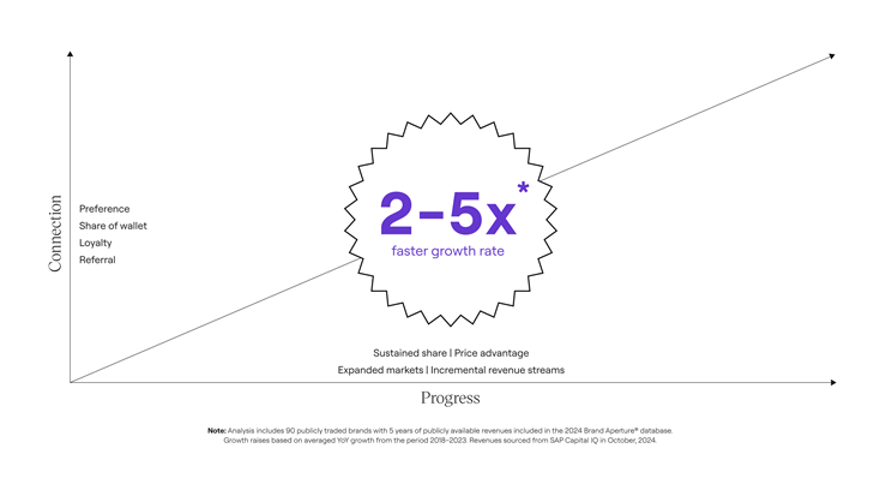 So, how does a brand build a meaningful relationship with its customers?.
Let’s break it down into two key elements:
First, your brand must forge a strong emotional connection with customers. Connection measures the emotional bond customers have with a brand. It can stem from shared values, a sense that the brand understands and cares for the customer, or a reflection of personal identity. Think of LEGO, a brand that scores high on connection because it’s a cultural force that inspires imagination and intergenerational play, blending craftsmanship, nostalgia, and storytelling into a powerful emotional experience.
In our experience, brands scoring well on this dimension tend to grow faster, but connection alone isn’t enough.
In addition to connecting with them, your brand must help customers make real progress in their lives. Progress measures how a brand helps customers do things they otherwise couldn’t. This includes functional innovation—better performance, ease of use, greater control—as well as social benefits like community building or positive societal impact. Think of Canva, a brand that democratizes graphic design by providing an intuitive platform that empowers creators while lowering traditional barriers.
Why it’s critical for connection and progress to work together
In our research, brands that score above the median on both connection and progress consistently stand out. When these two pillars reinforce each other, a brand becomes truly Go-to: more resilient, with loyal customers who are willing to follow it across adjacent offerings or forgive it for any missteps These brands are also more likely to see greater revenue growth.
Brands that excel on connection alone, enjoy emotional attachment but lack innovation or functional relevance. While beloved, they risk disruption if they fail to evolve. For brands in this predicament, some steps to take can include:
- Diversifying the innovation portfolio to feed a constant sense of “new and now,” making resetting expectations a way of life rather than a one-off
- Creating a signature innovation that’s a manifestation of your brand purpose
- Activating existing customer connections you have with your target customers to help them feel part of something bigger than themselves
By contrast, brands that excel only on progress risk losing customers once their technical advantage fades. These brands offer strong innovation or utility but lack emotional engagement—meaning customers may choose them out of necessity rather than preference, making them vulnerable to competitors who build stronger bonds (for example, customers switching quickly between Lyft and Uber purely because one offers a lower price per ride, rather than brand loyalty). For brands that excel on progress but need to drive emotional connection, here are some ways to start:
- Celebrating the brand’s distinct personality and defining how it fits seamlessly into customer’s everyday life.
- Linking the vision for a personal brand relationship to the business’s operations and economics to make it real; understanding and committing to the business implications.
- Designing a visual and voice expression that are authentic to the shared identity with the brand’s audience, and resonating with their journey and experience with your business.
Why momentum is key, and our list of the year’s strongest brands
Aside from driving connection and progress (the critical drivers of a Go-to Brand); we also measure a brand’s momentum. Measured by customer evaluations of whether a brand’s best days are ahead or behind, momentum is created through brand behaviors that signal growth —announcements of new or improved products, an expanded retail footprint, accelerated adoption and advocacy, and more—and how creatively these signals are marketed.
For brands looking to increase momentum, ask yourself: what’s in your pipeline that’s tangibly new, and how can it be brought to market in new and exciting ways that feel genuinely ahead, rather than “us-too”? How can it spark a more viral conversation beyond your core audience?
When we combined these three dimensions equally, in our 2025 list of the strongest brands, only 68 of the hundreds measured succeeded on all three dimensions. Of them, 14 brands emerged as leaders, each excelling in a unique way at building meaningful connections with customers.
Take Rivian, which stood out for “sharing its customers’ values.” Or Google, praised for being “easier to use” than competitors. Each Go-to Brand’s unique strength propelled its above-the-median performance and elevated it into the elite ranks.
And here’s the kicker: these brands don’t just grow faster—they’re also more resilient. During economic downturns, Go-to Brands lose only half as much market value as their peers.
In good times? Go-to Brands soar higher. In tough times? They hold stronger. That’s a measurable, undeniable win-win. For CMOs under constant pressure to justify every investment, that combination changes the conversation from belief to business case. So next time you pitch your boss on brand marketing investment, show them how building emotional connection and driving real progress for customers delivers ROI in every economic climate. It’s brand marketing that acts like all-weather economic protection – a kind of “green money” benefit no CEO can ignore. The grass isn’t just greener on the other side; it’s always greener as a Go-to Brand.