




Is AI Interest Waning? Beware the Hype Cycle

By Kenneth Rona, Ph.D., Chief AI Officer, JWX
While AI excitement has gripped the advertising industry for the past several years, it feels that we’re entering something of a dip. Recent headlines in major business publications include words like “underdelivering,” “alarm bells,” and “elusive returns.” Advertising is no different, because so many of the initial projects, especially those focused on agentic capabilities, are proofs-of-concept and not necessarily value-driving tools.
As a result, there is a vibe shift where many adopters now feel AI is too expensive to provide any kind of ROI. Believe it or not, the industry has been here before with platform adoption. Programmatic buying was not an immediate hit, and The Trade Desk was not always the front-runner in the media buying space.
With all new technological adoption, buyers will always learn to do just enough of what they need. But there’s a true advantage that comes from looking into platforms and technology more deeply. If we follow the same path at platforms, we can get out of this AI dip and start to see the true value.
Hitting a low point
The easiest way to understand this line of thinking is the Gartner Hype Cycle, which posits that every transformative technology passes through the same sequence. As the visibility of a technology grows, there are inflated expectations, aggressive spending, disappointing early results, retrenchment, and then, quietly, real value creation by the organizations that kept working while everyone gnashed their teeth.
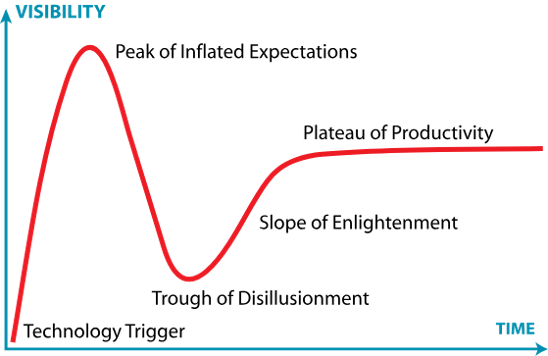
Agentic technology in advertising is now somewhere between disappointment and retrenchment. On the hype cycle itself, we’re nearing the “trough of disillusionment,” edged on by the relentless pace of empty announcements. Every vendor in the space, be it a DSP, SSP, agency network, or other point solution, has publicly declared its agent strategy. What we hardly ever see is any kind of follow up. Did the solution ever move beyond POC? Did an advertiser ever use it? Where are the case studies with numbers, the campaigns that ran end to end and were renewed, the workflow that stayed automated after the press release cycle ended? The industry has produced a great volume of agentic announcements and a small handful of robust agentic outcomes.
This gap is not evidence that the technology is hollow. It is evidence of a learning curve that most organizations have not yet climbed. Working with AI resembles learning to use a powerful shop tool. The first sessions are clumsy and slower than doing the job by hand. It is easy to conclude the tool is overrated and go back to what you know. The promised productivity gains arrive only after sustained use, when the operator has internalized what the tool is good at, where it fails, and how to structure work around it.
Most advertising organizations have adopted AI just enough for small gains. A chatbot here, a summarization tool there, modest gains, and then a plateau. Users, be they brands, agencies, or tech companies, have to push through this awkward middle period if they want to achieve materially better results.
There have been 70 years of investment in software designed around “deterministic” processes. Now, developers and product managers need to include agents in their thinking. Like people, agents need to be coached and corrected. The outputs are probabilistic, not deterministic, and that requires direction. The real value is that agents can exercise judgement without requiring constant supervision.
Achieving productivity
So where is the advertising market right now? Most organizations are still using deterministic processes. There are organizations that have gone through the “hard middle” and are not theorizing about agentic value. They are shipping campaigns in days that used to take weeks. These are still rare, and their scarcity explains the market’s current mood.
Within the tight world of programmatic advertising, it still seems like companies are in the initial stages of learning.
This is where everyone needs to fight against the sense of disillusionment. The lack of results and case studies isn’t necessarily a sign to give up, but a sign to keep pushing.
We’re in the early stages of a healthy correction. Agents that remain in the demo stage, looking for a problem to solve, aren’t going to carry value. But continued research and innovation are required, and that’s only possible with brands and agencies continuing to persevere and ask the right questions.
You May Also Like

The Best Agency-Client Relationships Are Built in the Trenches
When was the last time your in-house team handed you a Don Draper holy $#!* moment?

Evolving Commerce Media: How Offsite Unlocks the Full Funnel
Commerce media spent the last decade proving one thing exceptionally well: onsite ads drive immediate conversions. But treating commerce media purely as a bottom-funnel sales tool leaves most of the customer journey untouched.
The Entertainment Revolution: Why Brands Need to Think Beyond the Screen
As gaming, streaming and social media reshape how audiences experience entertainment, marketers face a fundamental challenge: Learning to participate in culture rather than simply advertise alongside it.