
It is mid-August. A parent sits down to write the back-to-school shopping list, and the first word is backpack. But that word did not arrive that morning. It came from a conversation in the car three weeks earlier, when the child said last year’s bag felt childish. From a short video, replayed enough times that the parent picked it up by osmosis. From a forum thread half-read in a waiting room. By the time it reaches the page, the decision behind it has already been made, by a committee the parent never knew they were on.
This is a problem for advertisers, because almost every back-to-school campaign turns up the moment that list exists. Display, search, retail media, retargeting: all of it is engineered around the cart. But the cart is the very end of the journey. Most of what decided it happened earlier, over eight weeks on the open web, while the brand sat waiting for an intent signal that only arrived once the decision was already lost.
“Most Back-to-School media investment is concentrated around the moment the cart is filled. But by the time a parent starts actively shopping, many of the key decisions have already been shaped through weeks of influence across content, social conversations, entertainment and peer-driven environments. Brands that wait for intent signals are often arriving after preferences have already formed.” – Luca Filardo, Chief Revenue Officer at Adlook
The data says the decision starts much earlier
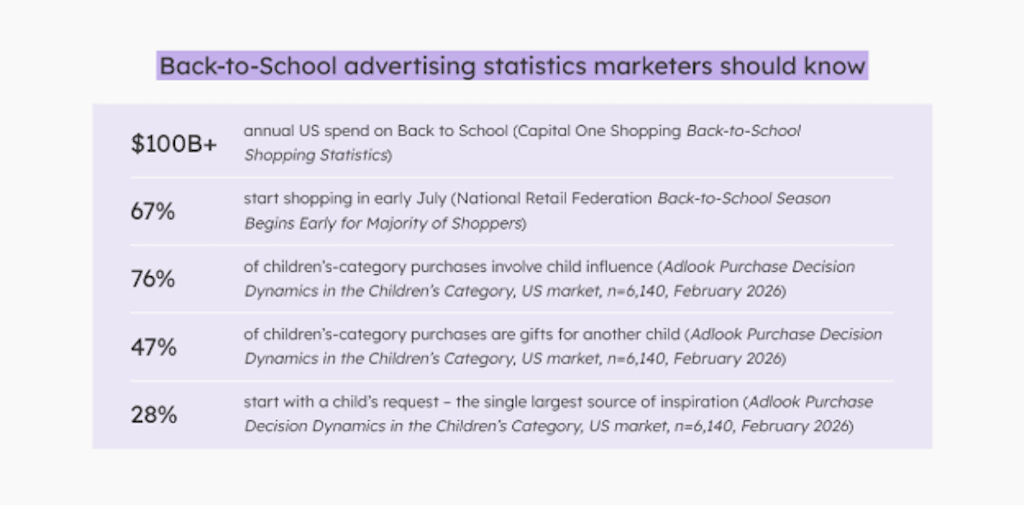
Adlook’s Purchase Decision Dynamics in the Children’s Category study* (US market, n=6,140, February 2026) found that 76% of purchase decisions in the category involve child influence. The single biggest trigger is the child simply asking for something, which accounts for 28% of all inspiration, ahead of advertising and reviews. In most households the parent is mostly ratifying a choice that began somewhere else.
The timing backs this up. US families spend more than $100B on back to school each year (Capital One Shopping), and 67% of them start shopping in early July (National Retail Federation). The real window runs eight to ten weeks. Search demand climbs through July while conversion stays flat, because people are still researching. Brands that mistake that early activity for purchase intent tend to spend heavily in August and then wonder why the numbers barely move.
 Two paths, one source
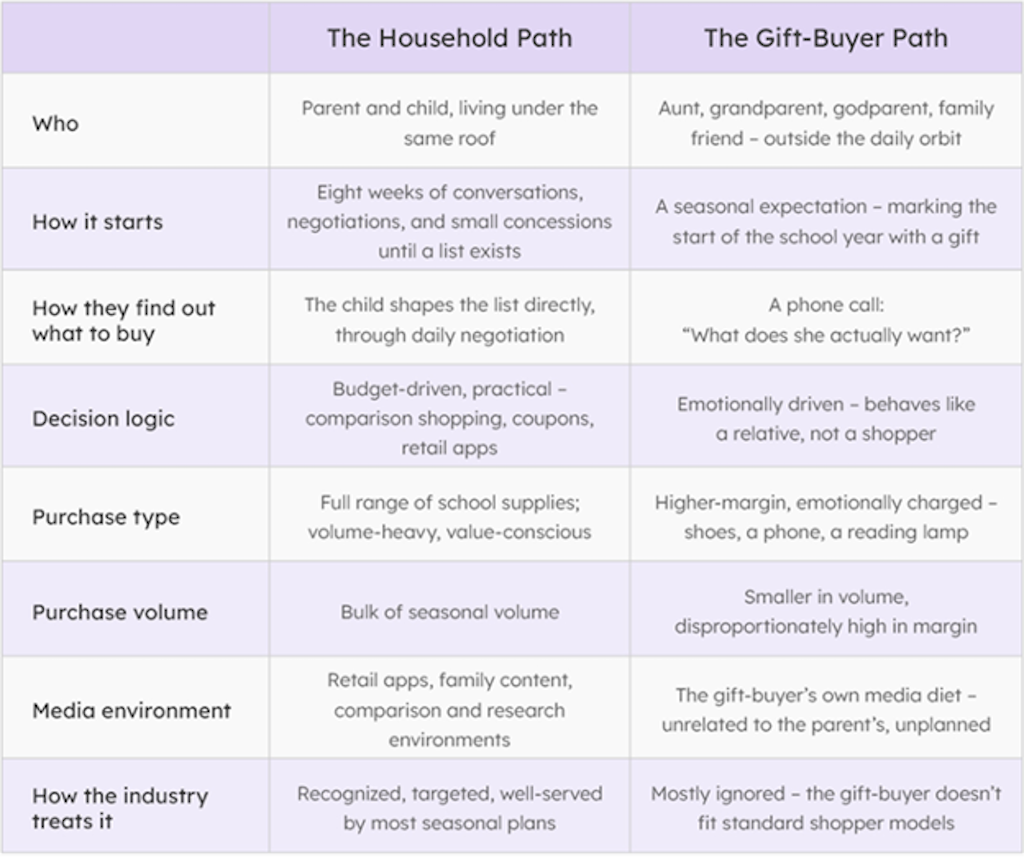
A back-to-school purchase does not happen one way, so one audience model will not cover it. The first path is the household one, which the industry already knows well: a parent and a child negotiating their way through the summer until a list and a budget exist. It carries most of the volume, and most seasonal plans are built for it.
The second path is the gift-buyer: a grandparent, an aunt, sometimes a godparent. Someone outside the child’s daily life who is still expected to mark the new school year somehow. Adlook’s study* found that 47% of purchases in the category are gifts for another child. That is close to half the market, and almost nobody plans for it. This buyer sits outside the household account and the retail-media data, so the parent’s brands never reach her. She also tends to spend more. Parents buy the practical backpack; grandparents buy the one with the logo.
 Both paths trace back to the same person. The child decides what the right backpack looks like, which sneakers pass, whether the notebook has the correct cover. The parent turns that into a budget. The gift-buyer turns it into a phone call: what does she actually want? Either way, a brand has to reach the child first, and then the adult who acts on the child’s preference.
 Where the decision actually forms
The late-funnel channels (search, retail media, social commerce, retargeting) are very good at capturing demand that already exists. Creating it in the first place is a different job. That happens somewhere quieter: a review on a parenting site in June, a thread about which lunchboxes survive the dishwasher, a CTV spot during family movie night when the child is in the room.
 All of this lives on the open web, which is the one place a brand can reach the parent, the child and the gift-buyer at once, without leaning on household data that only ever sees the parent. It also needs measuring differently. Metrics like attention and brand lift show what is working while the window is still open, instead of waiting until the season closes to credit July’s influence and August’s sales to the same line.
“The industry has become extremely effective at measuring conversion, but influence remains significantly under-measured. Back-to-School is one of the clearest examples of how consumer decisions are shaped long before a cart is filled. The brands that win are those that were present during the research, conversation and preference-building stages, not just at the point of purchase.” – Luca Filardo, Chief Revenue Officer at Adlook
The season breaks into phases, and each one rewards a different kind of presence:
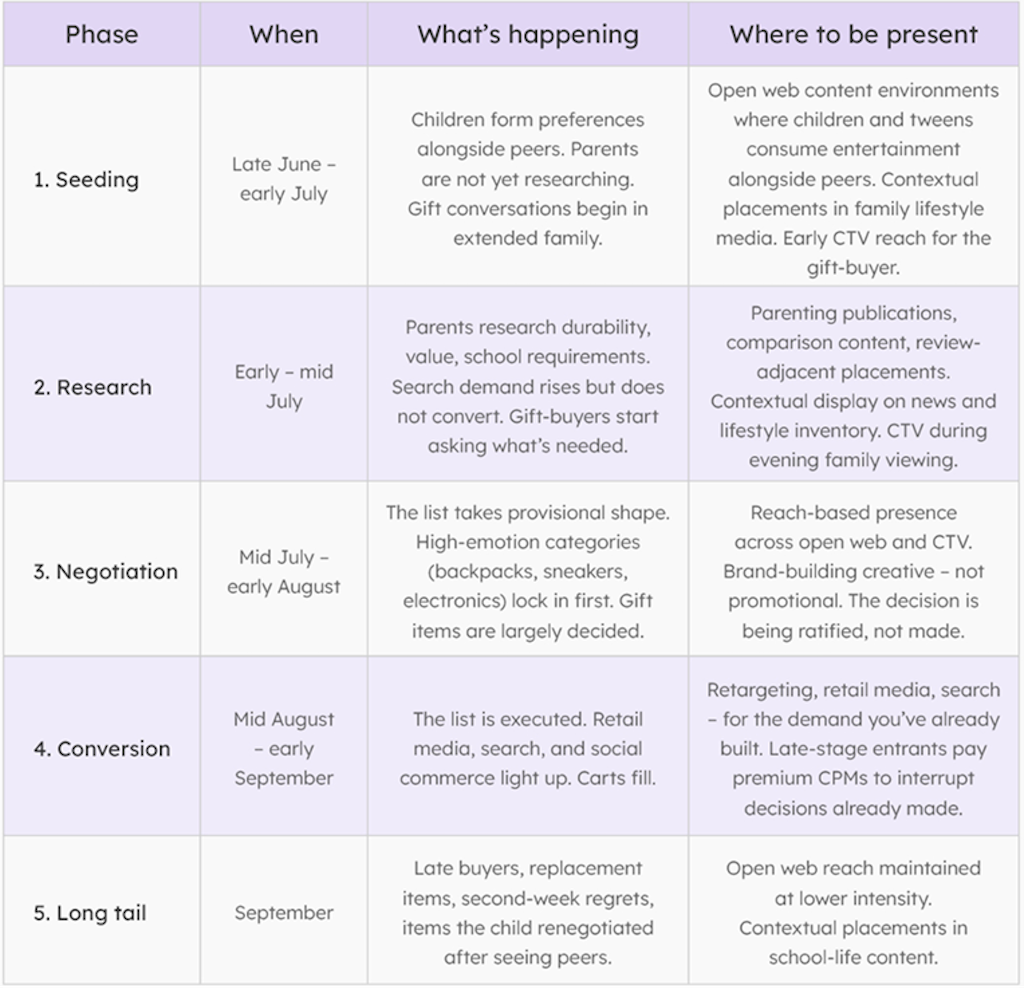 The work that decides this season happens earlier, while the child is still forming opinions and the parent has not started looking. The mid-August list is really a record of decisions made weeks before, and the names on it belong to whoever was already there in June.
The full Back-to-School Advertising Guide 2026, with the eight-week planning calendar and the three-audience framework, is available here: https://www.adlook.com/resources/back-to-school-advertising-guide/
*About the research: Data is drawn from Adlook’s Purchase Decision Dynamics in the Children’s Category study (US market, n=6,140, February 2026). The study used passive survey banners served programmatically across Adlook’s publisher network on standard IAB display placements. No audience or contextual targeting was applied, so respondents were reached randomly and the sample is representative of the general online population reachable on those placements. All responses are self-declared. Each respondent could be recorded once per question, and duplicate responses were removed before analysis.