For advertisers, the smartest media bets are on partners that know exactly who they are, who they serve and how your message fits naturally into that story.
By Estee Cross, Managing Director, Time Out North America
Picture it. New York City. 1995
Time Out comes across the pond from London, where it’s been a weekly must-read since 1968. It stands apart from stalwart newspapers and magazines because it speaks—really speaks—to young audiences about all things new, cool and compatible with their younger, smaller-than-stalwart wallets. It doesn’t just help them plan their lives; it brings them happiness and joy.
Fast forward to 2025
Time Out is here, connecting with Gen Zers, Millennials and our loyal Gen Xers—keeping Time Outers happy nationwide. Our mission—to entertain, inform and guide, all in the service of joy—hasn’t changed. What’s evolved is the proof. We now have the data to show that what we’ve always done in bringing joy to people’s lives is exactly what keeps our readers devoted and engaged, even as we continue to speak to new generations.
Turns out your media partner does have a “type” (and it matters)
A real brand identity isn’t a logo or a PowerPoint vibe check—it’s a worldview that makes every decision faster, smarter and more consistent for both publisher and advertiser. When that worldview is fuzzy, ad campaigns end up carrying the whole message, turning the media platform into a neutral container instead of a multiplier. But when it’s sharp, every ad benefits from a context already built, with shared values, expectations and a language the audience instinctively understands.
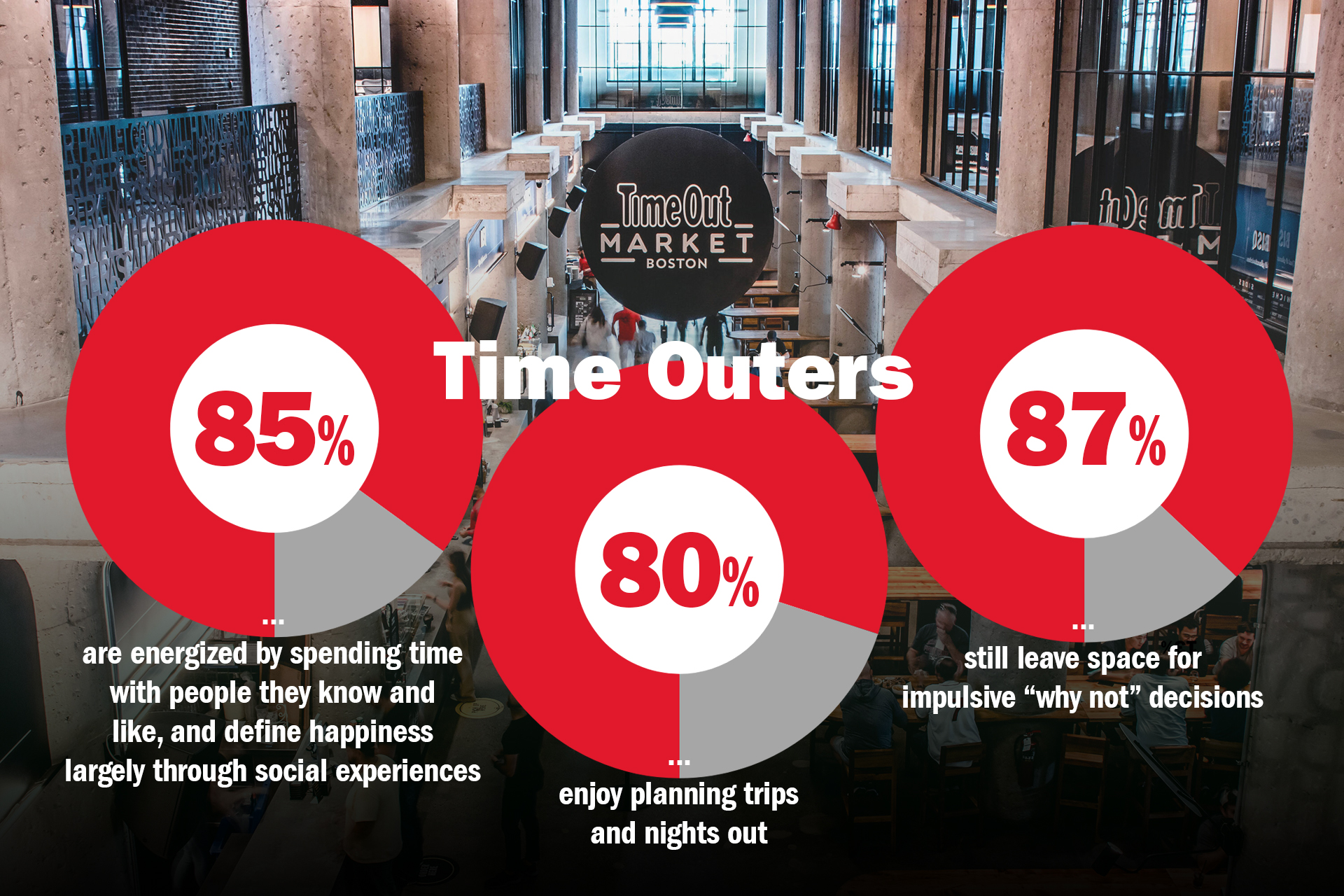
Most media brands think they know what they stand for; fewer can actually demonstrate it. Time Out did the homework. We talked to experts, dug into research and listened to thousands of real people to uncover something bigger than a marketing line: the pursuit of joy through social connection. In our research, we found an audience that feels energized by spending time with people they know and like, defines happiness largely through social experiences (85%), enjoys planning trips and nights out (80%), and still leaves space for impulsive “why not” decisions (87%). (Find the full report here.)
That’s how the Joy Revolution was born, not as a tagline but as a testament to what we’ve always done. People don’t just like going out. They crave the joy that comes from connecting, anticipating and being surprised. Naming it turned our intuition into a framework, one that powers everything from the media we make to the Markets we run around the world.
Why this matters now (hello, big global moments)
If you work on a brand or at an agency, you don’t need another thinkpiece about fragmentation or AI. You need to know how to show up meaningfully in the next 18 months of global attention: the Olympics, the World Cup and cultural moments that turn “just watching” into “actually doing something.”
Those moments aren’t just mass‑reach opportunities; they’re emotional spikes. People are gathering, planning, splurging, traveling, reconnecting. The question isn’t “How do I get my logo into the shot?” It’s “What role does my brand play in what people are actually feeling and doing right then?” That’s where a clearly defined media brand identity becomes a force multiplier.
If you partner with a media brand that can say, with data (that’s an important differentiator), “our audience comes to us when they’re planning, socializing or looking for spontaneous ideas,” you suddenly have a much cleaner brief. You’re not just buying impressions around an event; you’re tapping into a very specific behavior state.

From audience insights to actual levers
When a media brand knows its “type,” audience insights start reading like a checklist. Are these people planners? Last‑minute deciders? Homebodies who need a nudge or social butterflies who need a filter? Once that’s clear, cause-and-effect gets much easier to design.
For a marketer, that profile instantly suggests where your brand can credibly add value:
- Help them plan.
- Help them decide.
- Help them say yes faster.
That logic holds whether you’re a ticketing platform, a streaming service, a CPG brand or a sponsor of a global sporting event. You’re no longer shouting into the void; you’re speaking into a specific, pre‑existing conversation about how people want to live their lives.
What strong media identities give brands (beyond reach)
So what does this look like in practice when it’s working well? When you’re not just buying inventory, but buying into a clearly defined identity? A few patterns emerge again and again:
- You get built‑in context.
Your creative doesn’t have to explain everything from scratch. The media brand has already taught the audience how to read the environment, what to expect and what kind of recommendations to trust. - You get clearer roles.
Instead of vague “awareness,” you know this partnership is about turning inspiration into plans, or plans into bookings, or bookings into shareable moments. Roles are easier to measure than vibes. - You get better creative guardrails.
A sharp identity is a filter. It tells you what belongs and what doesn’t, which formats make sense and which ideas will land as forced. That’s a gift in the run‑up to big events where the temptation is to do everything, everywhere, with everyone. - You get a narrative, not just a media plan.
The best partnerships feel like they’re co‑authoring a story with the audience: here’s where you’ll be, here’s who you’ll be with, here’s how we’re making that better. A strong media brand identity gives that story a spine.

So what now? A few practical questions to ask
If this all sounds good in theory, here’s where it becomes useful in a brief. Before the next major moment on your calendar—whether that’s the Olympics, the World Cup or a citywide cultural festival—ask your media partners a few simple questions:
- Can you clearly articulate what your brand exists to do for people, in one sentence?
- Can you show me how that purpose shows up across editorial, social, events and product, and not just in your brand guidelines?
- Can you share audience insights that go beyond demographics and into motivations and behaviors tied to that purpose?
- Can you point to campaigns where your identity made the work better, not just bigger?
If the answers are vague, you’re probably buying reach. If they’re sharp, evidenced and aligned, you’re buying into a point of view—and that’s where the upside lives.
Where The Joy Revolution fits into all of this
For us, The Joy Revolution is simply the name we’ve given to our own answer to those questions. It’s how we’ve defined, empirically and emotionally, what our brand stands for and how it shows up in people’s lives.
The larger point, though, isn’t “be like us.” It’s that, in a year crowded with global spectacles and quickly changing trends, the real competitive edge for both media brands and marketers is clarity. Know your “type.” Partner with others who know theirs to build campaigns that don’t just appear in the moment, but actually belong there.
For more information about “The Joy Revolution,” click here.