




Vibe Coding is Reshaping the Mobile App Economy, With Big Implications for Advertising

By Henry Humadi (Ph.D), VP of Product, Supply @ Liftoff
Over the last six months, interest in “vibe coding” and AI-powered development tools has exploded.
At Liftoff, for example, we analyzed organic traffic for five top AI coding platforms – Cursor, Windsurf, Bolt, Lovable, and Base44 – from August to February. During that period, traffic grew from 2.14 to 4.22 million visits, a roughly 97% increase.
As these tools become mainstream, we’re seeing a fundamental shift in how software is created.
A New Wave of App Creation
The move to “vibe coding” is born out of more than technical convenience. It fundamentally reconfigures the cost of building software.
By decoupling the idea of a product from the syntax of traditional engineering, we’re witnessing a democratization of production, similar to how the internet democratized media. Now, the primary bottleneck in the app economy is no longer technical capital, but the clarity of your creative vision and how well the back-and-forth between human intent and AI-execution works.
App stores are already seeing this play out. In 2025, Apple’s App Store saw 557,000 new app submissions, a 24% year-over-year increase and the largest spike since 2015.
But what does this mean for mobile advertising? Well, it’s complicated.
How the App Boom is Reshaping Mobile Advertising
For Advertisers: More Opportunity and More Complexity
For advertisers, this massive change creates both opportunity and fragmentation. A larger app ecosystem means more inventory and more audiences, but also more noise. That can be challenging when in-app advertising is already relatively under-monetized, despite being where people overwhelmingly spend their time. More supply often translates to more complexity, a dynamic seen on the open web, where fragmentation has pushed spend to walled gardens.
For mobile advertisers, this reinforces the need to work with partners – from DSPs to SSPs and exchanges — that can connect them to high-quality in-app inventory. But that’s just the baseline. To navigate the complexity, the next step really lies in the deployment of agentic interfaces that can make and execute decisions.
An agentic DSP, for example, might autonomously reallocate budgets in real time based on performance signals across millions of new “vibe-coded” apps. Continuous, real-time optimization allows machine learning systems to ingest data, identify patterns, and improve decisions over time. These models determine where to bid, when to bid, and how much to pay, and are critical as the long tail of publishers explodes. This supports performance while reducing the millions wasted each year on manual ad optimization.
For sellers, an agentic SSP could dynamically optimize floor prices and inventory packaging by predicting buyer demand fluctuations before they happen. With these proactive, goal-oriented interfaces, platforms can enable both buyers and sellers to maximize revenue and ROI through execution that’s as rapid and fluid as the app creation process itself.
For Developers and Publishers: Competition and Differentiation
For developers and publishers, the rise of vibe coding is intensifying competition. In this new app gold rush, differentiation matters more than ever. More apps mean more competition for user attention and ad dollars. This makes long-term monetization increasingly dependent on insight and strategy.
The advantage will go to those who can effectively leverage data, not just from their own performance, but from the broader market. That includes using AI to analyze trends, identify whitespace, and uncover gaps. It also means conducting deeper competitive analysis across features, live events, roadmaps, and execution. In a world where anyone can build, the edge will go to those who best understand where to compete and what works best.
Finally, growth will depend on expanding where and how users are reached. A key emerging opportunity is cross-ecosystem discovery. Historically, verticals like gaming, retail, or finance dictated where advertisers showed up. But that’s changing. A 2025 report on casual gaming app trends shows that more than half of casual game installs, for example, now come from utility and entertainment apps, not gaming. This is a clear signal that growth will come from new strategies and thinking.
This trend also highlights a broader breakdown of traditional user groups, signaling a newfound “fluidity of user intent.” As the boundaries between utility, entertainment, and gaming continue to blur, predictive models must evolve to identify cross-vertical opportunities. The most successful developers will be those who recognize that a user’s interaction with a vibe-coded tool is often a stepping stone to engagement with a gaming or social platform, requiring a more holistic approach to user journey mapping that goes beyond static category labels.
In this environment, success will come down to making smarter decisions: where to invest, where to show up, and how to find real users in a fragmented landscape. As creation becomes easier, execution becomes the differentiator, and success will depend on effectively using data, automation, and the right tools to navigate that complexity.
You May Also Like

Podcaster Brinda Adhikari on Building Trust Through Curiosity, Not Correction
Brinda Adhikari, a journalist and the co-host of the podcast “Why Should I Trust You?,” joins host Drake Baer to discuss what it takes to build trust in science and public health across deep divides.
Add to Cart, Add to Culture: The Full-Funnel Commerce Evolution
Joining us is Abhay Singhal, co-founder and CEO of InMobi Advertising. Abhay explains what he means by agentic advertising and where early experiments with conversational ads are taking the industry.
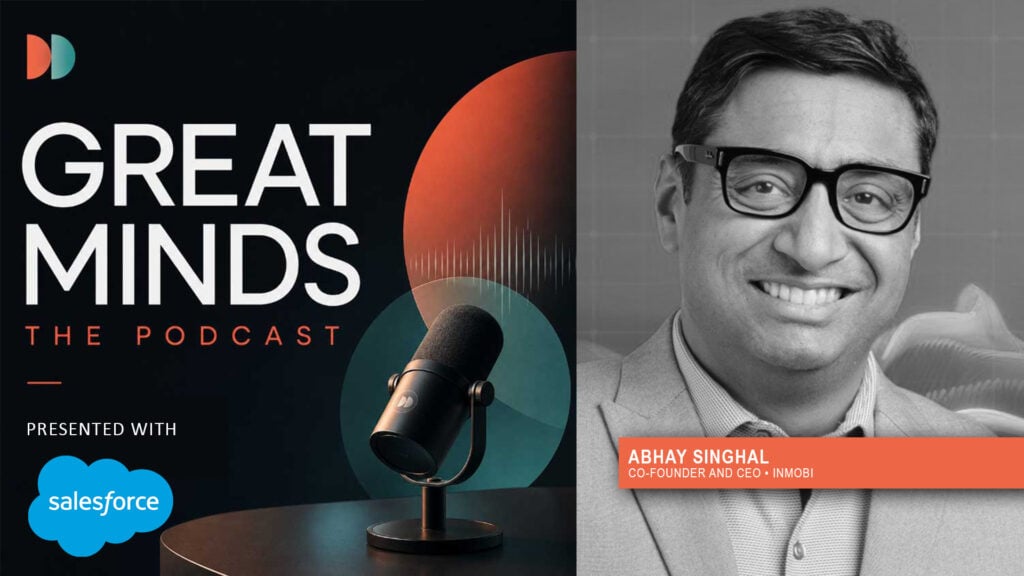
When the Customer Sends an Agent with Abhay Singhal of InMobi & InMobi Advertising
Joining us is Abhay Singhal, co-founder and CEO of InMobi Advertising. Abhay explains what he means by agentic advertising and where early experiments with conversational ads are taking the industry.