

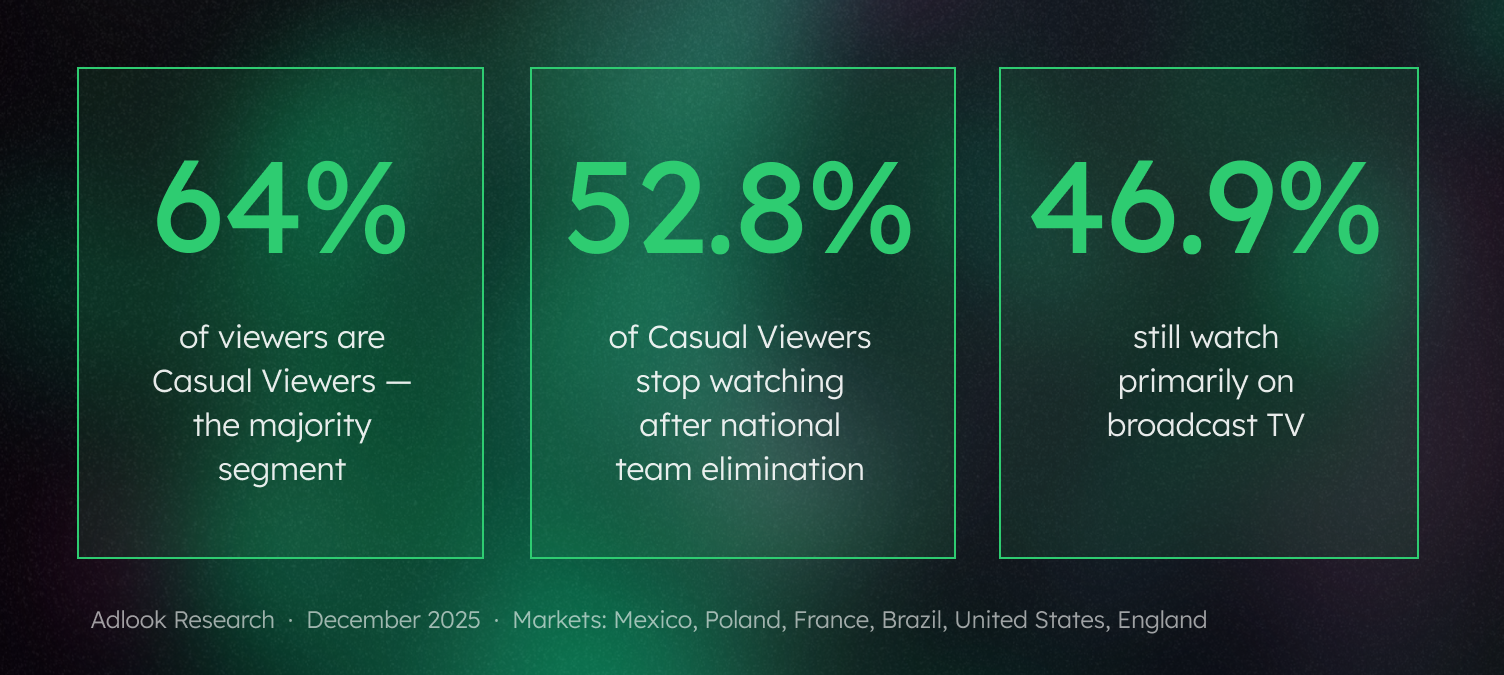
Adlook research across six markets shows that 64% of World Cup viewers are casual fans who stop watching the moment their national team is eliminated. For advertisers, that changes everything about campaign timing.
 Not all World Cup viewers are the same
Every four years, the World Cup draws one of the most powerful mass-media audiences on the planet. For brands, the instinct is simple: buy as much reach as possible, sustain it for as long as the tournament runs, and ride the wave to the final.
Adlook research, conducted across six markets in December 2025, challenges that instinct. The tournament audience is not a monolith, and understanding its structure has direct implications for campaign timing, creative strategy, and media spend.
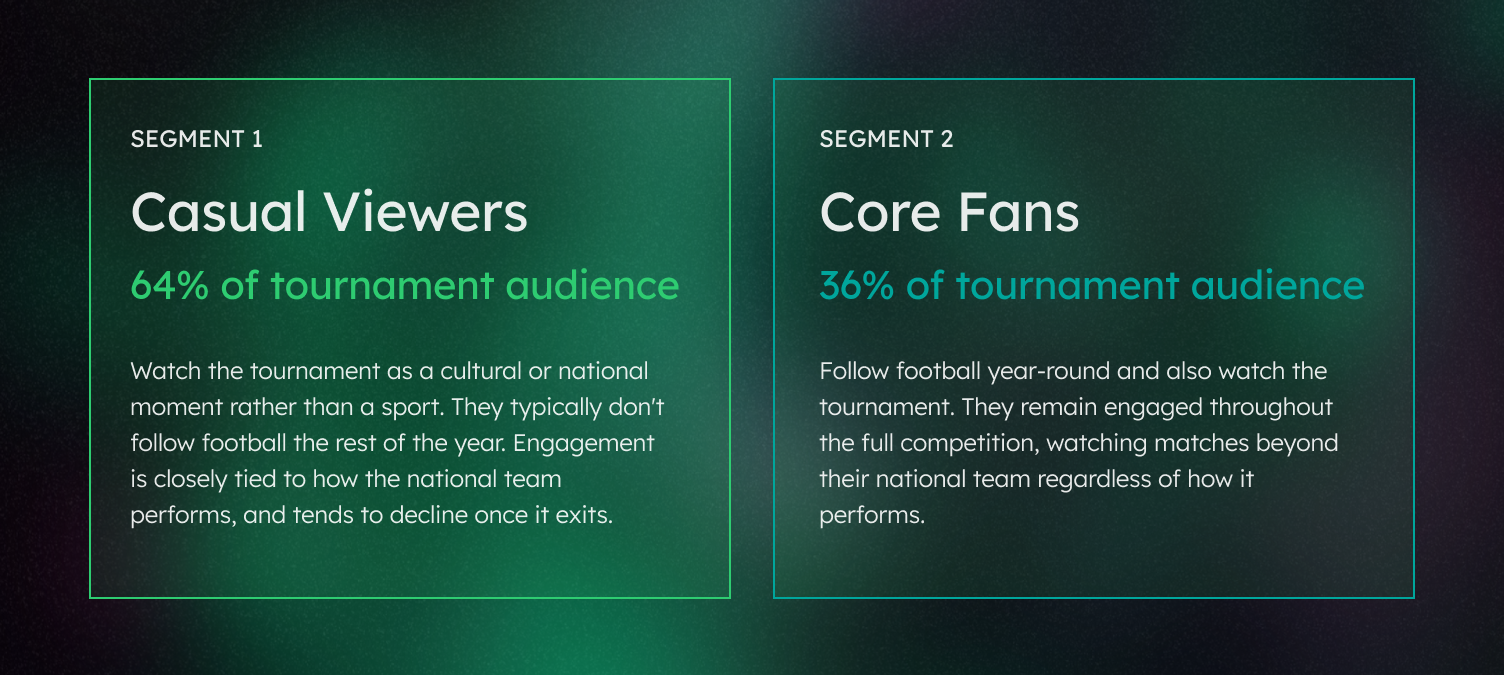
The research identifies two distinct viewer segments. Casual Viewers, 64% of the tournament audience, watch the World Cup as a shared cultural or national moment, not as football fans. They do not follow the sport year-round, and their engagement is almost entirely tied to how their national team performs.
Core Fans make up the remaining 36%. These are year-round football followers who stay engaged throughout the tournament regardless of national team results. These two groups behave differently across every dimension the study measured: what device they watch on, what they do during matches, and whether they keep watching once their country is knocked out.
 The elimination cliff
The most strategically important finding is what happens the moment a national team exits the tournament. Among Casual Viewers, 52.8% say they would stop watching after their team is eliminated. Among Core Fans, the picture is nearly reversed: 69.7% say they would continue watching regardless of national team results.
In practice, the tournament audience is at its broadest and most diverse during the group stages, then progressively narrows toward a core of hardcore football fans as the competition advances. A campaign that reached a wide consumer audience in week one may be targeting a fundamentally different, much smaller audience by the quarter-finals.
Brands that hold budget back for the semi-finals or final are paying a premium to reach the smallest and most homogeneous slice of the original audience.
Where and how people watch
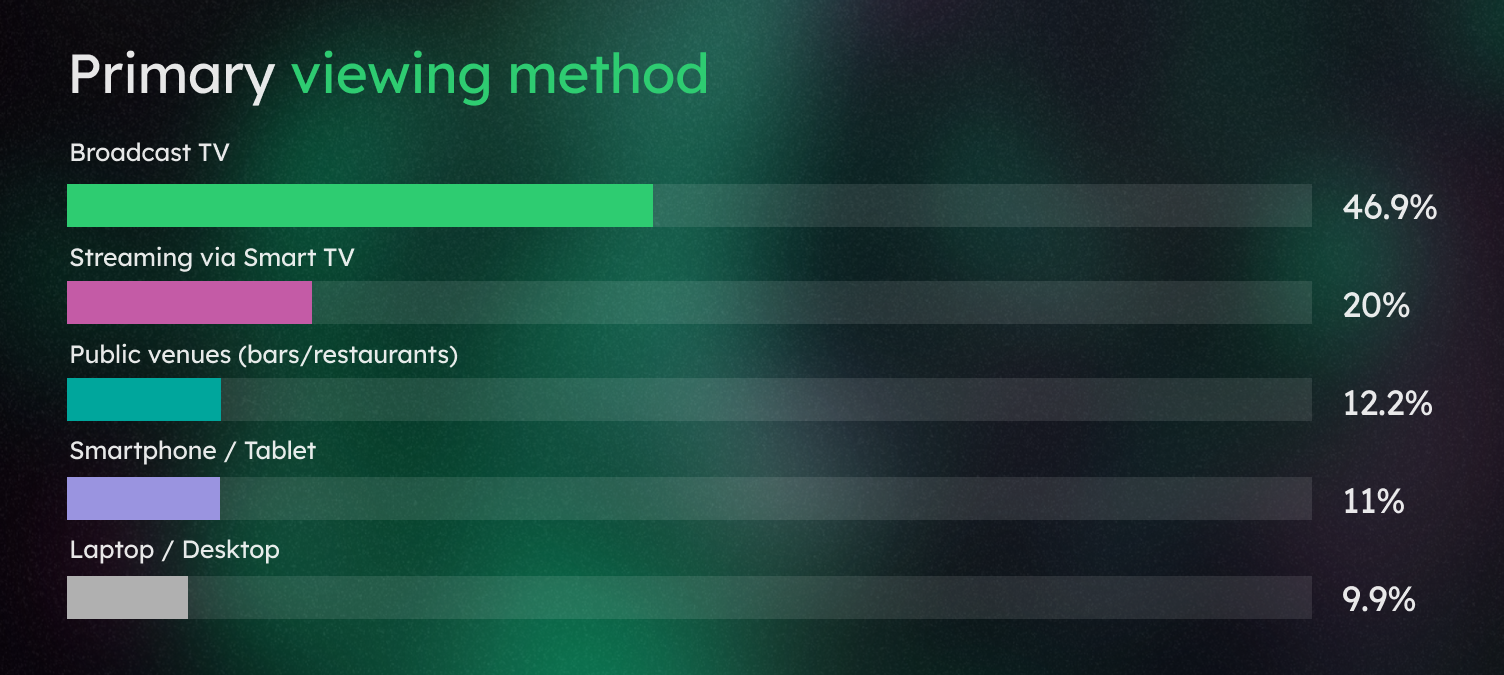
Despite the continued growth of streaming, broadcast TV remains the primary viewing platform. 46.9% of viewers watch primarily on traditional television, 20% via streaming on Smart TV, 12.2% at public venues such as bars and restaurants, and 11% on smartphones or tablets.
Core Fans over-index on digital: 38% watch via streaming or digital platforms. Casual Viewers lean toward broadcast, and are 8% more likely to report giving the match their full, undivided attention, suggesting that for the majority segment, the broadcast window is genuinely focused viewing time.
 What viewers do during matches
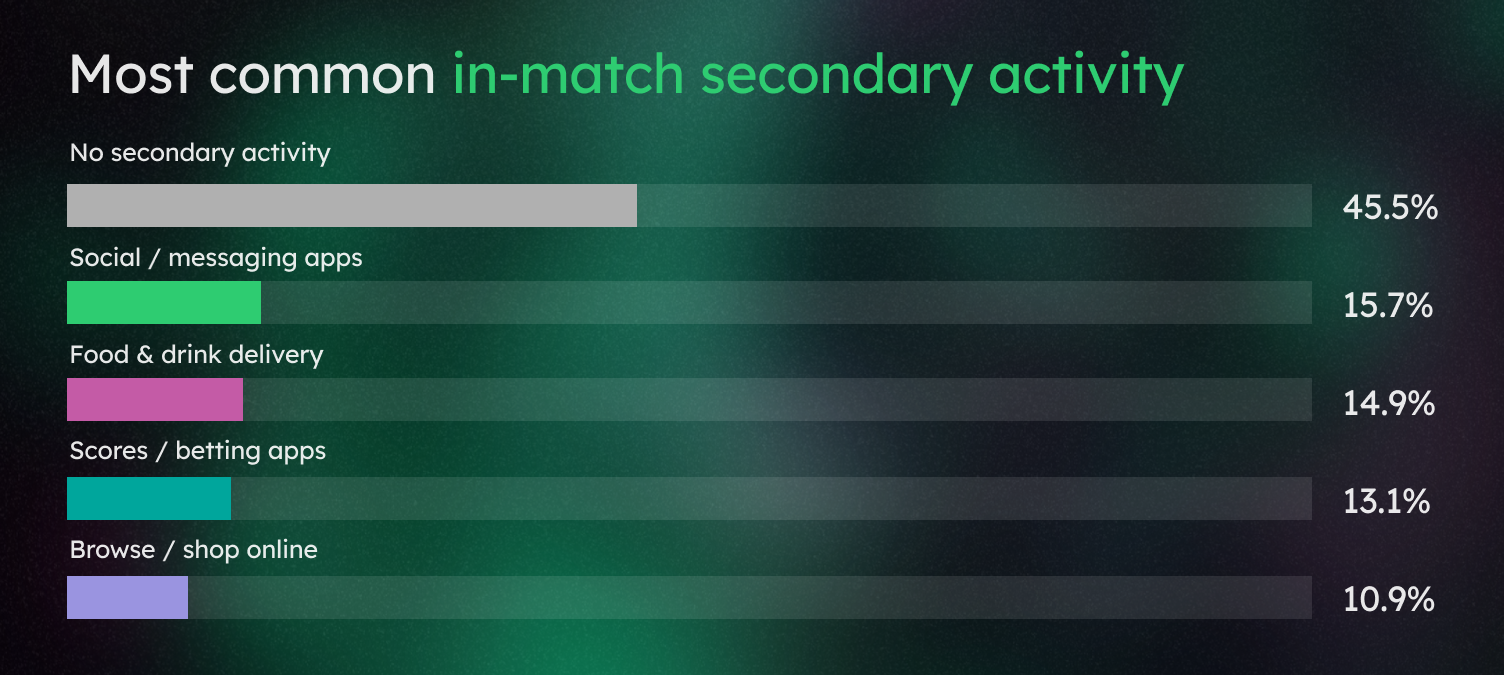
Even highly engaged viewers often have a second screen nearby. When asked about their most common secondary activity during matches, 45.5% of respondents report no secondary activity at all. Among those who do use a second screen, the most common activities are social and messaging apps (15.7%), food and drink delivery (14.9%), scores and betting apps (13.1%), and browsing or shopping online (10.9%).
The segment differences are commercially relevant. Casual Viewers are 32% more likely to browse or shop online during matches compared to Core Fans, who gravitate toward sports apps and live score tracking. The high rate of food and drink delivery reflects how most people actually watch: at home, with others, treating it as a social occasion.
 For brands in food, drink, delivery, and retail, the in-match second-screen window represents a real-time activation opportunity, one that is disproportionately accessible through the casual majority.
What it means for campaign planning
Three concrete conclusions emerge from the data.
First, front-load media weight. The group stage is when the audience is largest and most diverse. Holding back budget for later rounds means targeting a smaller, more concentrated audience at a higher cost.
Second, plan for audience composition to shift, not just size to decline. As the tournament progresses, the remaining audience skews increasingly toward Core Fans: less commercially reactive, more focused on the sport itself. Creative and targeting strategies built for a casual cultural audience in week one will need to evolve.
Third, connect broadcast with second-screen environments. Cross-screen strategies that link TV exposure with concurrent digital touchpoints are likely to outperform broadcast-only approaches, particularly for reaching Casual Viewers while they are active on their phones during the match.
Download the full Adlook report: https://www.adlook.com/world-cup-audience-behaviors-report/
Methodology: Adlook Global Football Tournament Audience Behavior Study, December 2025. Markets: Mexico, Poland, France, Brazil, United States, England. All results represent self-reported survey data and should be treated as directional behavioral insights.