

By Andrew Bolton, Chief Customer Officer, Knotch
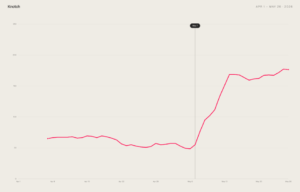
Something shifted in mid-May. ChatGPT started sending more visitors to brand websites, and those visitors were increasingly landing somewhere marketers may not have expected: the homepage. In customer journey data collected by Knotch, AI-driven referral traffic from ChatGPT roughly doubled in a matter of days.
The shift underneath the shift
It is tempting to read this as another reason to chase LLM visibility. That is certainly important, but there is a bigger picture shift. What changed is not how ChatGPT cites brands. What changed is where it is funneling that intent. And it’s intent, not visibility that drives revenue.
For two years, the dominant view about LLMs from marketers has been that they are a referral traffic sink. The LLM answers the question. The user never clicks (“the zero-click world”). Pipeline that used to come from search dries up. That view was correct, and it shaped how brands thought about AI. Get visible, show up in the answer, cross your fingers, move on.
That thinking needs to rapidly evolve. AI is a growing direct referral source. Brands need to do more than simply get mentioned more often. They need website experiences that are built to receive AI-native traffic and convert it.
What’s wrong with my website?
Consider the journey of an AI-native visitor. They asked ChatGPT a question. The model responded with a hyper-personalized response, tailored to their intent, and surfaced three or four recommendations. Your brand was one of them. They clicked (Hooray!).
But this person is not the visitor your website was designed for. They did not arrive from a campaign, so your tracking parameters are blank. They did not arrive from organic search on a keyword, so you cannot infer their intent. They did not arrive from paid, so you have no creative context to lean on. They arrived with a different intent, and an expectation of intelligence, shaped by AI.
Knotch’s behavioral data, drawn from post-LLM traffic across our customer base, makes the cost of this disconnect clear: 80% of AI-native visitors bounce, and roughly 1% convert. The fastest-growing referral channel in the marketing stack is delivering pre-qualified, high-intent visitors to website homepages, and four out of five are turning around and leaving. That is not a traffic problem. That is an experience problem.
The new directive
The strategic shift for marketing and digital leaders should not be simply to”rank higher in ChatGPT.” It’s something more fundamental: meet the expectations of an AI-native consumer.
To understand what that means, look at the experience the visitor just left. ChatGPT had a conversation with them. It read their intent in real time, assembled an answer specifically for them, and adapted as they followed up. Then it handed them off to your website, where they encountered a static page, fixed navigation, and a journey designed for the masses. The drop-off in the experience is jarring, and the data confirms it.
Marketers need to rethink what the website is built to do. If AI is sending visitors from a conversational, intent-rich experience, the website cannot greet them with a static page and a generic path. It needs to respond more like the interface that sent them there. Marketers should focus on three changes now.
Turn pages into knowledge. AI-primed visitors should not have to scan, scroll, and assemble the story themselves.They arrive with a specific question or need, and the website should make the next answer easy to find.The new directive is to organize content around customer questions, use cases, comparisons, proof points, and decision criteria instead of treating the homepage as a general brand brochure.
Design for intent and adaptation. The pre-planned customer journey assumes the brand knows where the visitor is going before they arrive. That assumption is broken. AI-primed visitors arrive at unpredictable points with unpredictable questions, often skipping the steps the funnel was built to move them through. Marketers need to design websites to read intent in the moment and adapt — surfacing different content, in different sequences, for different visitors, based on what they actually need rather than what the journey map predicted.
Make discovery more conversational. The visitor’s last interaction was a dialogue. They asked a question and got an answer. They asked a follow-up and got another. Then they landed on a website and were asked to start over — read the headline, click the nav, scan the page, find what they came for. Brands should be thinking about what each step away from the conversational interface costs: trust and attention.
None of this means abandoning the website. It means evolving it from a brochure into a living interface. A surface that brings the brand’s knowledge to the visitor, adapts to who they are and what they need, and meets them in the conversational register they have already been trained to expect.
The AI referral moment will not be won in the answer box alone. It will be won on the pages visitors landed on next. Marketers have spent years optimizing for discovery. Now they need to optimize for the AI-primed visitor who arrives ready to act, but still needs the website to meet them with relevance, context, and direction.